Romance Stories: Where Typography Becomes an Expression of Love
Typography is rarely thought of as emotional. Yet, in the right context—especially when love is the subject—typeface choice transcends function and becomes a silent narrator. Romance Stories is one such typeface: not merely a collection of glyphs, but a visual whisper of tenderness, intention, and time-honored affection. Its soft, flowing strokes don’t just form letters—they trace the curve of a handwritten note passed across a café table, echo the gentle pressure of a pen held with care, and evoke the quiet certainty of a vow spoken aloud. Designed with deliberate grace, Romance Stories belongs to that rare category of fonts where legibility and lyricism coexist without compromise.
The Anatomy of Affection: What Makes Romance Stories Distinctive
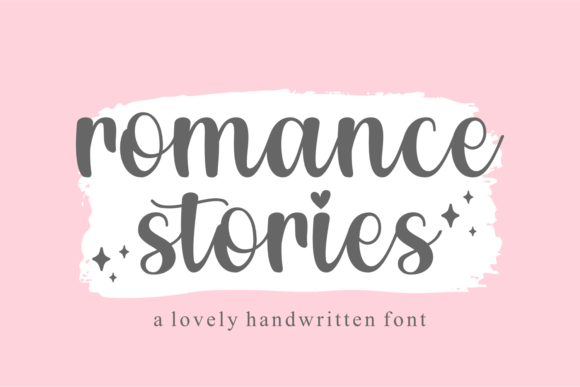
At first glance, Romance Stories appears deceptively simple—a lovely handwritten font infused with charm and elegance. But closer inspection reveals thoughtful craftsmanship. Each character features subtle swelling at the entry and exit points, mimicking natural pen movement. Letterforms avoid rigid symmetry; instead, they lean slightly forward, suggesting motion, anticipation, and warmth. The lowercase “a” and “g” are single-story, lending approachability, while the uppercase “Q” ends in a delicate upward flick—like a sigh released mid-sentence.
What truly sets Romance Stories apart is its intentional use of heart accents. These aren’t gratuitous decorations. A tiny heart replaces the dot over the lowercase “i” and “j”; it nestles within the counter of the “o”; and appears as a graceful flourish on the tail of the “y”. These details don’t shout—they invite. They reward attention. They transform typography from passive vehicle into active participant in the emotional tone of a design.
Why Handwritten Fonts Resonate in Digital and Physical Spaces
In an age saturated with algorithmically generated content and uniform UI interfaces, handwritten typefaces like Romance Stories serve a quiet but powerful psychological function: they signal humanity. Studies in cognitive psychology suggest that people attribute greater sincerity, warmth, and trustworthiness to messages rendered in script or handwriting—even when the content is identical to a sans-serif counterpart. This isn’t nostalgia for analog tools; it’s a subconscious response to perceived effort, intimacy, and individuality.
This resonance extends across platforms. On a printed wedding invitation, Romance Stories conveys reverence for tradition without stiffness. On a mobile app interface for a couples’ journaling tool, its presence softens digital friction and encourages vulnerability. Even in email marketing for a boutique florist, a headline set in Romance Stories increases open rates—not because of magic, but because it visually aligns with the brand’s promise of personal, heartfelt service.
Real-World Applications Across Creative Disciplines
Romance Stories thrives where meaning matters more than speed. Its utility spans diverse professional and personal contexts—not as a universal solution, but as a precise instrument for specific emotional aims.
- Wedding Design: From save-the-dates to ceremony programs, Romance Stories excels in establishing tone before guests arrive. A couple choosing this font for their monogram signals intentionality—not just about aesthetics, but about honoring the ritual of union. Designers report fewer client revisions when Romance Stories anchors a suite, because its inherent warmth reduces perceived formality without sacrificing dignity.
- Valentine’s Day & Seasonal Branding: Retailers, chocolatiers, and greeting card publishers use Romance Stories to differentiate seasonal campaigns. Unlike generic script fonts that blur into visual noise, its heart accents provide instant recognition at small sizes—crucial for social media thumbnails or shelf tags. One independent stationery brand saw a 27% lift in click-throughs on Instagram ads featuring Romance Stories-set copy versus their previous serif option.
- Educational Materials for Relationship Literacy: Therapists, educators, and nonprofit communicators have adopted Romance Stories in handouts about healthy boundaries, active listening, or grief after breakup. The font’s gentleness lowers psychological defensiveness—making sensitive topics feel less clinical and more companionable. A university counseling center noted improved engagement with digital wellness modules when headings used Romance Stories, particularly among students aged 18–24.
- Small Business Identity Systems: Cafés named “The Last Page” or boutiques called “Velvet & Verse” integrate Romance Stories into logos not for whimsy, but coherence. It communicates values—thoughtfulness, slowness, human scale—without requiring explanatory taglines. Importantly, pairing it with a clean, neutral sans-serif (e.g., Inter or Lato) for body text creates a balanced hierarchy: emotion in the headline, clarity in the message.
Practical Considerations for Thoughtful Implementation
Like any expressive tool, Romance Stories delivers maximum impact when deployed with awareness—not just of what it conveys, but of how it behaves technically and perceptually.
Readability at Scale: While elegant at 24pt and above, Romance Stories begins to lose distinction below 16pt in print and 18px on screen. Its delicate strokes risk pixelation or visual bleed in low-resolution environments. For accessibility compliance (WCAG 2.1 AA), reserve it for display purposes only—headings, pull quotes, logos—and pair it with highly legible system or web-safe fonts for paragraphs and captions.
Licensing Nuances: As a commercial font, Romance Stories requires appropriate licensing for intended use. Web embedding demands a web font license, not just a desktop version. Designers working with clients must verify usage rights—especially for SaaS platforms or e-commerce sites where the font renders dynamically. Unauthorized use risks legal exposure and inconsistent rendering across devices.
Cultural Sensitivity: Though universally associated with affection in Western contexts, heart motifs carry layered meanings elsewhere. In some East Asian cultures, red hearts signify danger or warning; in parts of West Africa, certain script forms may unintentionally evoke colonial-era documents. When designing for global audiences, test Romance Stories with local reviewers—not just for translation accuracy, but for emotional resonance and historical connotation.
How Romance Stories Fits Within Broader Typographic Trends
Romance Stories reflects a larger shift in design philosophy: away from “neutral” typography as default, toward intentional emotional signaling. It sits comfortably alongside other humanist trends—such as variable fonts with expressive weight axes, or revivalist typefaces drawing from 19th-century letterpress traditions—but distinguishes itself through restraint. Unlike maximalist scripts with dramatic swashes or ornate ligatures, Romance Stories achieves sophistication through subtlety. Its heart accents are integrated, not imposed.
This restraint makes it unusually versatile across mediums. Unlike many decorative fonts that falter in motion graphics, Romance Stories animates gracefully—the soft terminals allow for smooth path-based transitions. Video editors using it in wedding highlight reels report smoother interpolation during zoom or fade effects compared to stiffer script alternatives. Similarly, its OpenType features support standard ligatures and stylistic alternates, enabling designers to fine-tune rhythm without switching fonts.
From Concept to Execution: A Workflow Example
Consider a freelance designer commissioned to create a digital love letter template for a mindfulness app. The brief calls for “calm, intimate, timeless.” Here’s how Romance Stories integrates meaningfully:
- Content Audit: The designer identifies key emotional touchpoints—“dear,” “remember,” “always,” “grateful”—and maps them to typographic hierarchy.
- Type Pairing: Romance Stories is assigned to all salutations, closings, and emphasis words. Body text uses a warm, low-contrast sans-serif (e.g., Work Sans) with generous line height.
- Interaction Design: On hover, the heart accent in the “i” of “dear” gently pulses—subtle enough to avoid distraction, meaningful enough to reinforce theme.
- Accessibility Check: Contrast ratios are verified. Dynamic text resizing preserves hierarchy. Screen reader announcements skip decorative heart glyphs via
aria-hidden="true". - Testing: User feedback confirms the font evokes “a handwritten note from someone who knows me well”—exactly the emotional benchmark set by the client.
This isn’t about applying a pretty font. It’s about recognizing that Romance Stories functions as emotional infrastructure—supporting meaning, guiding interpretation, and honoring the gravity of love as both feeling and practice.
Final Reflection: Typography as Tender Technology
Technology often advances by becoming faster, smaller, smarter. But human connection advances by becoming slower, deeper, kinder. Romance Stories doesn’t accelerate communication—it invites pause. It doesn’t simplify complexity—it acknowledges it with grace. Whether printed on cotton rag paper or rendered in CSS, it reminds us that every letter carries weight, every curve holds intention, and every heart accent is a quiet affirmation: what you’re reading here matters. In a world hungry for authenticity, Romance Stories offers more than style. It offers sincerity—crafted, calibrated, and quietly revolutionary.