Benetta: A Handwritten Script Typeface for Elegant, Personal Typography
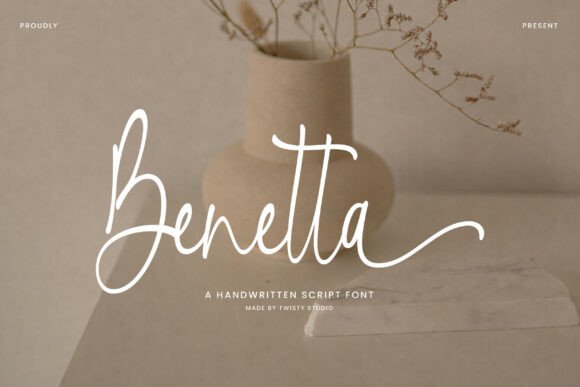
Benetta is a handwritten script typeface designed with flowing strokes, gentle curves, and expressive details that emulate natural penmanship. It belongs to the modern script category—distinct from formal copperplate or casual brush scripts—emphasizing warmth, rhythm, and visual softness without sacrificing legibility at moderate sizes. Unlike monoline or highly decorative scripts, Benetta balances personality with restraint, making it suitable for contexts where authenticity and refinement are both priorities.
Designers, brand strategists, and content creators often explore Benetta when seeking a typeface that conveys approachability and sophistication simultaneously. Its appeal lies not in novelty alone, but in how its letterforms support specific communicative goals: evoking intimacy in wedding stationery, suggesting artisanal care on product packaging, or adding human texture to digital campaigns. These use cases reflect practical needs—not just aesthetic preference—but they also raise questions about appropriateness, technical constraints, and long-term usability.
When Benetta Aligns With Your Goals
Benetta performs well in projects where tone matters as much as information. For example:
- Wedding and event invitations: Its graceful connections and subtle variations in stroke weight reinforce formality without stiffness, supporting emotional resonance without overwhelming the message.
- Small-batch or premium product branding: On labels, tags, or minimalist packaging, Benetta signals craftsmanship and attention to detail—especially when paired with clean sans-serif companions for body text.
- Social media visuals and digital storytelling: Used selectively—as headlines, quotes, or short callouts—it adds visual warmth to otherwise uniform feeds, helping content stand out while maintaining coherence.
In these scenarios, Benetta’s strength lies in its consistency of voice. It doesn’t mimic handwriting unpredictably; instead, it offers controlled variation—like natural pen pressure or slight slant shifts—that feels intentional rather than arbitrary. This makes it more reliable than fully irregular handwritten fonts when building scalable design systems.
Practical Considerations and Tradeoffs
Like all script typefaces, Benetta has functional boundaries. Its connected letterforms and low contrast between thick and thin strokes mean it’s generally unsuitable for extended reading. Body copy, legal disclaimers, or interface labels should use a complementary sans-serif or serif face. Even at headline sizes, spacing adjustments (tracking and kerning) may be needed to ensure clarity—particularly in all-caps settings or tight layouts.
Another consideration is language support. Benetta includes standard Latin characters and common diacritics, but does not extend to Cyrillic, Greek, or extended Vietnamese character sets. Projects requiring multilingual compatibility may need supplemental fonts or fallback strategies.
Technical implementation also warrants attention. While Benetta is available in OpenType format with ligatures and stylistic alternates, not all platforms render advanced typographic features consistently. Web use requires proper font hosting and CSS configuration (e.g., font-feature-settings) to access discretionary ligatures or swashes—features that enhance elegance but aren’t essential to core functionality.
Where Alternatives May Be More Appropriate
Benetta isn’t the optimal choice for every handwritten-style need. Consider alternatives if:
- You prioritize high legibility at small sizes: Fonts like Quicksand (a rounded sans) or Playfair Display (a high-contrast serif) offer warmth with stronger readability in constrained spaces.
- Your project demands strong contrast or bold presence: Scripts such as Lavanderia or Brittany Signature deliver higher stroke contrast and dramatic flourishes—better suited for logos or large-format signage where impact outweighs subtlety.
- You need broad language coverage or variable font support: Open-source options like Patrick Hand or commercial variable scripts like Scriptina Pro offer wider character sets or responsive weight/width axes that Benetta lacks.
It’s also worth noting that Benetta’s design philosophy leans toward understated elegance—not playful energy or vintage nostalgia. If your brand voice relies on quirk, irony, or historical reference (e.g., 1920s apothecary labels or children’s book illustrations), other scripts may communicate more directly.
Making an Informed Choice
Evaluating Benetta effectively means matching its attributes to your project’s functional and expressive requirements—not just its visual appeal. Start by identifying your primary use case: Is it for static print materials, responsive web layouts, or motion graphics? Then assess technical needs—character set breadth, file size, licensing scope (desktop vs. web vs. app), and whether you’ll need OpenType features beyond basic glyphs.
Test Benetta in context before committing. Render sample text at intended sizes and weights alongside supporting typefaces. Check contrast ratios for accessibility compliance if used in UI elements. Review how it behaves across devices—especially mobile screens where fine script details can blur or disappear.
Finally, consider longevity. Benetta’s restrained style avoids trend-driven exaggeration, which supports consistent brand expression over time. However, its effectiveness still depends on thoughtful application: pairing, spacing, color contrast, and hierarchy. A beautiful script misapplied can dilute rather than enhance messaging.
In summary, Benetta serves best when warmth, elegance, and human-centered tone are central to your communication goals—and when its limitations around legibility, language support, and technical flexibility align with your production environment. It’s a tool with clear strengths and defined boundaries, not a universal solution. Evaluating it alongside your specific constraints and objectives—not against abstract ideals of “beauty” or “uniqueness”—leads to more sustainable, effective typographic decisions.