Anestesie: A Handwritten Script Typeface Built for Refined Visual Identity
Typography choices carry quiet but significant weight—especially when conveying tone, heritage, or intention. Anestesie stands apart as a handwritten script typeface designed not for whimsy or trend-chasing, but for sustained elegance and deliberate craftsmanship. It’s the kind of font that feels at home on a limited-edition perfume bottle, a boutique wedding invitation suite, or the masthead of a thoughtfully curated lifestyle publication—not because it shouts, but because it settles in with confidence and restraint.
What Makes Anestesie Distinctive—Beyond Aesthetic Appeal
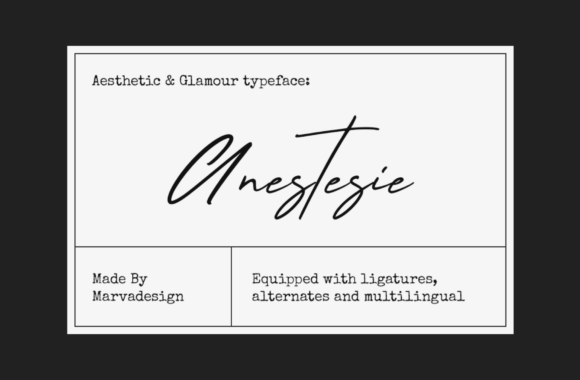
Anestesie isn’t just “handwritten-looking.” Its letterforms are built from continuous, fluid strokes that mimic natural pen movement—yet they’re precisely balanced for visual consistency across sizes and contexts. Unlike many script fonts that sacrifice legibility for flourish, Anestesie maintains clarity even at smaller point sizes (down to 14–16pt in print or high-res digital use), thanks to generous x-heights, open counters, and carefully modulated stroke contrast.
The design includes built-in ligatures and stylistic alternates—not as decorative extras, but as functional tools. These aren’t gimmicks; they’re subtle variations that prevent repetition fatigue in longer text blocks, such as event programs or product storytelling copy. For example, using the alternate “&” or swash “t” in a logo lockup adds distinction without compromising cohesion. That level of typographic nuance reflects thoughtful development, not just stylistic imitation.
Multilingual Support That Works—Not Just Checks a Box
Many elegant scripts limit users to Western European languages, creating friction for global brands or inclusive creative teams. Anestesie supports over 200 Latin-based characters—including extended diacritics for Romanian, Turkish, Polish, Vietnamese, and more—as well as currency symbols, numerals, and punctuation adapted for diverse typographic environments. This means a Berlin-based skincare brand can confidently use Anestesie across German, English, and French packaging copy without switching fonts mid-layout. Likewise, a bilingual wedding stationer in Montreal won’t need workarounds for accented French names.
That support extends beyond character coverage: spacing and kerning have been tested across language-specific word structures. You’ll notice tighter pairings in Italian (“la”, “che”) and adjusted spacing around diacritics in Spanish (“cañón”, “niño”), reducing manual adjustments during production.
Where Anestesie Delivers Practical Value
Its strength lies in focused application—not versatility across every use case. Anestesie excels where voice, identity, and emotional resonance matter most:
- Brand logotypes and submarks: Paired with a clean sans-serif (e.g., Inter, Neue Haas Grotesk), Anestesie provides warmth and differentiation without sacrificing professionalism.
- Packaging for premium goods: From ceramic tableware labels to small-batch chocolate wrappers, its organic rhythm complements tactile materials and artisanal positioning.
- Editorial highlights and social assets: Use it sparingly—for pull quotes, cover lines, or Instagram story headers—to elevate key messaging without overwhelming readers.
- Invitations and ceremonial print: Its graceful ascenders and descenders lend gravitas to formal occasions, especially when printed on textured cotton paper or foil-stamped.
It performs reliably in both print and screen environments—tested at 72ppi web use and 300dpi CMYK output—with no hint of pixelation or inconsistent hinting. Glyph rendering remains stable across Adobe Creative Cloud apps, Figma (via variable font plugins), and modern browsers—no unexpected fallbacks or missing characters in live previews.
Real-World Considerations—and When to Pause
Anestesie is intentionally narrow in scope: it’s a display face, not a text face. It shouldn’t be used for body copy, data tables, UI labels, or accessibility-critical interfaces. Its lowercase-only design (with optional small caps via OpenType features) also means all-caps usage requires careful attention—some ligatures may not activate, and spacing can tighten unexpectedly without manual kerning.
Also worth noting: while the alternates add flexibility, overusing them risks visual inconsistency. A logo benefits from one intentional variation; a full-page brochure with randomized swashes can feel disjointed rather than organic. Professional typesetting practice still applies—Anestesie enhances skill, it doesn’t replace it.
For designers working under tight deadlines or with limited typography experience, pairing Anestesie effectively takes some familiarity with hierarchy and contrast. It pairs best with neutral, highly legible sans-serifs—not other decorative or high-contrast fonts. Testing combinations at actual size (not just thumbnails) helps avoid unintended tonal clashes.
Who Benefits Most—and How They Use It Well
Small business owners launching a luxury service—say, a private interior design studio or a bespoke fragrance line—find Anestesie valuable because it communicates care and curation without requiring custom lettering. The font delivers immediate credibility when applied consistently: same treatment on website hero text, business cards, and thank-you notes builds recognition faster than starting from scratch.
Freelance designers and branding consultants appreciate its reliability across client projects. One designer reported using Anestesie across three unrelated clients in six months—a sustainable fashion label, a classical music festival, and a specialty coffee roaster—each time adapting its weight and spacing to match distinct brand personalities. That repeatability speaks to its structural integrity.
Educators teaching typography or branding often cite Anestesie in student briefs to demonstrate how script fonts function within systems—not as standalone decoration, but as part of a considered typographic hierarchy. Its OpenType features offer tangible examples of real-world font functionality beyond basic character sets.
A Measured Recommendation for Intentional Design
Anestesie isn’t about chasing visual novelty. It’s a tool for designers and creators who prioritize coherence, cultural awareness, and material honesty in their work. Its value emerges not in isolation, but in how it supports broader goals: strengthening brand memory, honoring linguistic diversity, and elevating everyday touchpoints with quiet sophistication.
If your project calls for warmth without informality, elegance without excess, or distinction without distraction—Anestesie earns its place in your toolkit. It rewards attention to detail, responds well to thoughtful pairing, and holds up across formats and audiences. Used with intention, it doesn’t just look refined—it helps you communicate refinement.