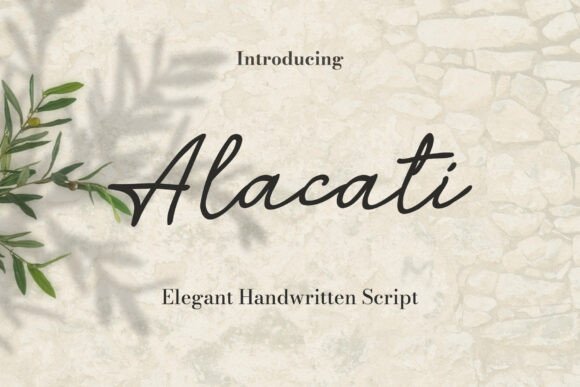
Alacati: A Handwritten Script Rooted in Mediterranean Grace
Alacati isn’t just another script font—it’s a quiet gesture toward intentionality. Inspired by the hush of coastal evenings in Çeşme, the soft rhythm of sea air against whitewashed walls, and the unhurried elegance of small-batch craftsmanship, Alacati translates that atmosphere into typographic form. Its strokes breathe: slightly irregular, gently tapered, and connected with organic ease—not rigidly calligraphic, but thoughtfully human. That balance—between control and spontaneity—is what makes it both distinctive and deeply usable.
Why Designers Reach for Alacati (Beyond Aesthetics)
What sets Alacati apart isn’t just how it looks—it’s how it behaves in real projects. Unlike many handwritten fonts that sacrifice legibility for flair, Alacati maintains clarity at medium sizes (14–24 pt), especially in print. Its open counters, moderate contrast, and consistent x-height support readability without flattening its character. It’s not meant to shout; it’s designed to invite closer attention—ideal when your message relies on tone as much as content.
For branding professionals, that means Alacati works where personality matters most: a boutique skincare line communicating purity and ritual, a seaside café emphasizing warmth over trendiness, or a slow-fashion label underscoring material honesty. It doesn’t compete with imagery—it complements it, adding texture without visual noise.
Real Applications, Not Just Concepts
Here’s where theory meets practice—how people actually use Alacati across formats:
- Restaurant menus & wine lists: Paired with a clean sans-serif (like Poppins or Inter) for body text, Alacati shines in dish names, section headers, or short descriptors—“Grilled octopus, lemon thyme, olive oil” gains subtle sophistication without pretension.
- Wedding stationery: Used for names, dates, or ceremony details on thick cotton paper, it evokes intimacy without cliché. Try light letterpress or muted foil stamping to honor its delicate weight.
- Fashion campaign typography: On lookbook covers or social banners, Alacati adds tactile warmth next to high-res photography—especially effective for linen, ceramic, or hand-dyed textile brands.
- Packaging for artisan goods: Think olive oil, small-batch preserves, or handmade soap. Its flow echoes the care behind the product—no need for ornate borders or embellishments.
- Editorial features & literary journals: As pull quotes, chapter openers, or masthead accents, it introduces voice and pace—slowing the reader down just enough to land the idea.
Adapting Alacati Across Audiences and Platforms
How you use Alacati shifts meaningfully depending on who’s receiving it—and where:
For small business owners: Start simple. Use Alacati only for primary brand elements—your shop name on signage, your tagline on Instagram highlights, or the “About” header on your website. Avoid overloading it across every button or caption. Consistency builds recognition; restraint preserves impact.
For freelance designers: Present Alacati as part of a system—not a standalone flourish. Show clients how it pairs: maybe with a warm neutral serif (like Adobe Garamond) for long-form web copy, or a crisp geometric sans for navigation. Demonstrate hierarchy: Alacati for “Our Story,” then a functional typeface for the rest. That approach signals professionalism—not just taste.
For educators and creators: When teaching typography or branding, use Alacati to illustrate *tone alignment*. Ask students: “Does this font feel like a luxury resort lounge—or a sun-bleached fish market? Why?” Its Mediterranean roots make it a strong anchor for discussions about cultural resonance, regional identity, and emotional coding in type.
Keeping It Clear, Cohesive, and Authentic
Alacati rewards thoughtful application—but missteps are easy. Here’s how to avoid them:
- Respect its scale. It thrives at 18–36 pt in print and 24–48 px on screen. Below that, detail blurs; above that, its delicacy risks feeling fragile rather than refined.
- Limit color variation. Stick to one or two ink tones—deep navy, charcoal, or warm black work best. Avoid gradients or heavy shadows that muddy its natural flow.
- Don’t force contrast. If your brand uses bold, saturated visuals, Alacati may need breathing room—set it against generous negative space, not busy patterns.
- Test with real content. Run sample menu items or product descriptions through it. Does “Smoked paprika + goat cheese crostini” read cleanly? If not, adjust tracking or size before finalizing.
Most importantly: let Alacati serve the message—not the other way around. Its strength lies in subtlety. A well-placed “Thank you” in Alacati on a receipt feels personal; using it for an entire terms-of-service page undermines both utility and intent.
Where Alacati Fits in Today’s Creative Landscape
In an era of algorithm-driven templates and AI-generated visuals, Alacati stands out by being quietly human-made—with all the slight asymmetries and considered pauses that implies. It doesn’t chase virality. Instead, it supports work rooted in place, craft, and care: the independent publisher launching a poetry chapbook, the ceramicist labeling her studio collection, the chef documenting seasonal recipes for a printed zine.
That’s not nostalgia—it’s relevance. Brands and creators increasingly recognize that authenticity isn’t signaled by rawness alone, but by consistency of voice and respect for context. Alacati helps articulate that. It doesn’t solve design problems by itself—but paired with smart layout, intentional color, and purposeful writing, it becomes part of a cohesive, audience-centered solution.
If you’re evaluating typefaces for an upcoming project, ask yourself: does this need energy—or presence? Boldness—or nuance? Alacati answers the latter. It won’t dominate a layout—but it will linger in memory, like the scent of salt and wild thyme after a walk along the coast.