BreakLove
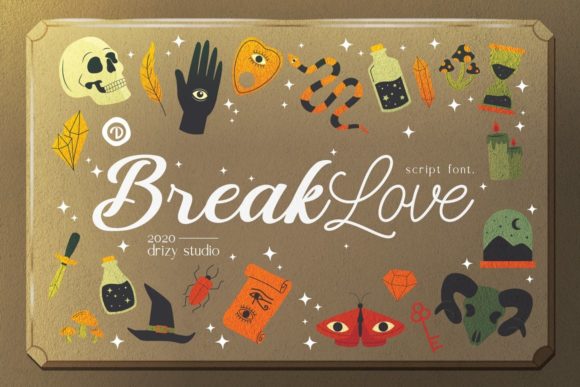
BreakLove isn’t just another handwritten font—it’s a confident, expressive voice on the page. Designed with bold strokes, intentional imperfections, and rhythmic energy, BreakLove reads like a hand-drawn declaration: present, personal, and unapologetically human. It’s not meant for body text or fine print. It’s made for moments that need to land—headlines that stop scrollers, logos that stick in memory, and designs that whisper *“this was made with care.”*
Where BreakLove Fits in Real Creative Work
Think about the last time you saw a wedding invitation that felt warm but never cloying—or a boutique coffee shop’s neon sign that looked handmade, yet perfectly legible from across the street. That’s BreakLove territory. Its strength lies in context: it shines where authenticity matters more than uniformity, and where personality needs to be felt—not just seen.
Small Businesses Building Identity From Scratch
For solopreneurs, makers, and local studios, branding often starts with one powerful visual anchor: the logo. BreakLove gives a small-batch candle brand, a ceramicist’s online shop, or a neighborhood florist an instant tonal advantage—confident without being corporate, nostalgic without feeling dated. One designer used BreakLove for her skincare line’s monogram logo; customers repeatedly told her it “felt like something I’d trust my skin with.” That’s not accidental. The font’s slight irregularity signals craft, not automation—and that builds quiet credibility.
Wedding & Event Designers Who Prioritize Emotion Over Perfection
Wedding stationery is one of BreakLove’s most natural homes. Unlike ultra-thin scripts that vanish on textured paper or overly ornate fonts that compete with floral motifs, BreakLove holds weight and warmth. It works beautifully on letterpress invitations, foil-stamped menus, or even chalkboard signage—especially when paired with clean sans-serif body text. A real-world note: designers report fewer client revisions when using BreakLove for “Save the Date” headers because its balance of boldness and flow feels both celebratory and grounded.
Content Creators & Social Media Managers Looking for Standout Visual Hooks
On crowded feeds, typography is your first impression—and often your only chance to differentiate. BreakLove’s high-contrast swashes and dynamic baseline make quote graphics pop without needing extra illustration. A wellness coach uses it for Instagram carousel headers (“You’re allowed to rest”), while a poetry account layers short stanzas over muted backgrounds using BreakLove for the title line only—keeping attention anchored and emotional tone intact. Because it’s PUA encoded, accessing alternate glyphs (like flourished capitals or connecting swashes) takes seconds in design apps—no digging through character maps or installing extras.
Who Might Want to Pause Before Using BreakLove
Like any strong creative tool, BreakLove thrives when matched to intention—not just aesthetics. It’s not built for every job, and knowing where it *doesn’t* fit is just as useful as knowing where it excels.
When Legibility Needs to Be Absolute
BreakLove is expressive, not utilitarian. It’s not ideal for signage requiring quick comprehension at a distance (think airport wayfinding), legal disclaimers, or interface labels in apps. Its connected letters and variable stroke widths mean it demands space, light background contrast, and thoughtful sizing. At 14px on screen? It’ll blur into abstraction. At 60pt on a poster? It commands attention—gracefully.
When Brand Voice Calls for Neutrality or Authority
A financial advisory firm, university department, or medical practice may lean toward clarity, restraint, or tradition. BreakLove’s warmth and personality—while deeply appealing in many contexts—can unintentionally soften perceived expertise in fields where precision and stability are primary signals. That doesn’t mean it’s off-limits forever—but it does mean pairing it thoughtfully (e.g., BreakLove for a campaign headline, balanced by a crisp, neutral sans-serif for supporting text) is essential.
When You’re Working With Tight Technical Constraints
While BreakLove supports OpenType features and PUA encoding, some platforms—especially older CMS templates, email builders, or basic presentation tools—may not render custom glyphs or ligatures reliably. If your workflow depends heavily on web-safe fallbacks or limited font loading options, test early. Many users find success embedding BreakLove via modern web font services (like Adobe Fonts or self-hosted @font-face) for landing pages and campaigns—but default to system fonts for internal documents or PDFs sent to clients with unpredictable software.
Practical Tips From Designers Who Use BreakLove Weekly
- Start with hierarchy: Use BreakLove only for top-level emphasis—logo wordmarks, section headers, or hero text. Let supporting type do the work of explanation.
- Respect its rhythm: BreakLove has natural spacing and cadence. Avoid cramming letters too tightly or stretching tracking unnaturally—it loses its organic feel.
- Pair intentionally: It sings next to geometric sans-serifs (like Montserrat or Inter), warm grotesques (like Nunito or Manrope), or even restrained serifs (like Merriweather). Avoid competing scripts or overly decorative companions.
- Print with purpose: On uncoated paper or textured stock, its boldness absorbs beautifully—but on glossy finishes, consider slightly increased letter spacing to prevent ink spread from muddying details.
- Test color contrast: Its thick strokes can dominate light grays or pastels. For accessibility and impact, aim for deep charcoal, navy, black, or rich jewel tones against clean whites or soft creams.
Why BreakLove Feels Different in 2024 (and Beyond)
In an era saturated with AI-generated visuals and algorithm-optimized templates, BreakLove stands out precisely because it resists polish-by-default. Its subtle inconsistencies—the slight tilt in an uppercase “B,” the tapered exit stroke on an “R,” the way certain lowercase letters invite connection—are evidence of human decision-making. That’s increasingly valuable. Not as nostalgia for the past, but as intentionality for the present.
It’s the kind of font a photographer chooses for her studio name on a gallery wall. The kind a podcast host selects for their show’s intro graphic—not because it’s trendy, but because it matches the tone of voice they’ve spent years refining. It’s not flashy. It’s not trying to be everything. It’s simply, unmistakably, there—with presence, warmth, and quiet confidence.
If you’re looking for a font that helps your message feel less like content and more like connection, BreakLove isn’t just an option. It’s a starting point—with handwriting that remembers how to breathe.