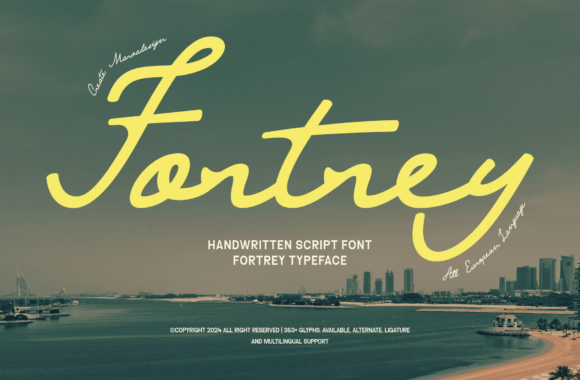
Fortrey: A Timeless Script Font for Elegant, Nostalgic Design
Fortrey is a classic script handwritten font designed to balance vintage charm with contemporary usability. Unlike many decorative scripts that prioritize flair over function, Fortrey was crafted with intention—its smooth, rounded contours and refined line weight create visual harmony without sacrificing legibility at moderate sizes. It’s not merely ornamental; it’s engineered for expression, offering subtle personality while remaining grounded in typographic discipline.
What Sets Fortrey Apart from Other Script Fonts
Many script fonts fall into one of two categories: highly formal calligraphic styles (often dense and difficult to read in body text) or casual, irregular handwriting fonts (which can feel inconsistent across words or lack typographic polish). Fortrey occupies a thoughtful middle ground. Its letterforms feature gentle modulation—slight thick-to-thin transitions that suggest hand-drawn authenticity without dramatic contrast that compromises clarity.
A key differentiator is its attention to rhythm and flow. Characters connect organically, and the spacing between letters has been tuned to avoid crowding or awkward gaps. This isn’t just about aesthetics—it affects how quickly a viewer reads a word or phrase. In branding or editorial use, that subtle consistency helps reinforce tone and trust.
Fortrey also includes a curated set of stylistic alternatives and ligatures—not as an overwhelming library, but as purposeful options. For example, alternate lowercase “a” and “g” forms offer slight variations in openness and shape, letting designers adjust warmth or formality without switching fonts entirely. These aren’t gimmicks; they’re tools for fine-tuning voice.
Where Fortrey Fits in Real-World Design Projects
Fortrey excels where tone matters as much as content. Consider a small-batch artisanal brand launching a new line of botanical teas: the packaging benefits from typography that feels personal, considered, and quietly luxurious. Fortrey delivers that impression—not loud or flashy, but confident in its restraint. Similarly, wedding invitations often seek elegance without cliché; Fortrey avoids overused flourishes while still evoking timelessness.
In editorial design, it works well for pull quotes, section headers, or masthead treatments—places where a human touch elevates written material without competing with body text. Because its x-height is generous and ascenders/descenders are moderate, it holds up better than many scripts when scaled down to 18–24px for web display.
That said, Fortrey is not intended for long-form reading. It lacks a full set of small caps, true italics, or extensive language support beyond Latin-based scripts. If your project requires multilingual typesetting (e.g., supporting accented characters for French, Spanish, or Polish), you’ll need to verify coverage—or plan for fallbacks.
Comparing Fortrey With Broader Script Categories
When evaluating script fonts, it helps to group them by intent and structure:
- Formal calligraphy fonts—like those modeled after copperplate or Spencerian penmanship—offer high contrast and sharp angles. They communicate tradition and ceremony but often require larger sizes and tighter tracking to remain legible. Fortrey trades some of that precision for approachability and smoother digital rendering.
- Casual handwriting fonts tend toward irregularity: varying baseline alignment, uneven stroke weights, or exaggerated slants. While expressive, they can undermine professionalism if used broadly. Fortrey maintains a consistent baseline and balanced rhythm, making it more versatile across contexts.
- Modern brush scripts emphasize texture and energy—often mimicking marker or brush strokes. They suit youthful, energetic brands but may feel out of place in heritage-focused or minimalist work. Fortrey’s cleaner lines and softer edges lend themselves to quieter sophistication rather than bold immediacy.
This doesn’t mean Fortrey is “better”—just differently calibrated. Its strength lies in restrained expressiveness: enough character to stand out, enough discipline to integrate seamlessly.
Practical Tradeoffs to Consider
Like any specialized typeface, Fortrey comes with realistic constraints. It’s a single-weight family—no bold or light variants. That means designers must rely on size, color, or layout hierarchy to create emphasis, rather than typographic weight. If your workflow depends heavily on weight contrast (e.g., pairing a bold headline with a regular subhead), you’ll need to supplement Fortrey with a compatible sans or serif companion.
Its OpenType features are focused and functional—not exhaustive. You’ll find standard ligatures and common alternates, but not contextual swashes or automatic glyph substitution chains found in more elaborate script families. That’s intentional: Fortrey prioritizes predictability over complexity. For designers who prefer manual control and clean output—especially in print production or responsive web environments—this is an advantage, not a limitation.
Also worth noting: Fortrey performs best in controlled settings. On low-resolution screens or in fast-loading web contexts where font loading is delayed, its subtlety can be lost. Pairing it with a robust system font as a fallback ensures message continuity even before the custom font renders.
When Fortrey Is Likely the Right Choice
Fortrey shines in projects where emotional resonance and quiet distinction matter most. Think of:
- A boutique hotel rebranding its stationery and website headers—seeking warmth without informality.
- An independent publisher designing covers for literary fiction—where typography should suggest care and craft, not trendiness.
- A lifestyle brand developing seasonal campaign materials—needing a consistent voice across Instagram graphics, email headers, and printed lookbooks.
In each case, Fortrey supports the message instead of overshadowing it. It doesn’t scream for attention; it invites closer reading.
When You Might Explore Other Options
If your project demands high functional flexibility—such as supporting multiple languages, requiring tight micro-typography (like legal disclaimers or footnotes), or needing robust variable font capabilities—Fortrey may not be the primary tool. Similarly, if your audience skews younger and responds strongly to kinetic, textured, or playful visuals, a more dynamic brush or chalk-style script could align better with expectations.
And if budget or licensing scope is a constraint, consider whether Fortrey’s usage rights match your distribution needs—especially for SaaS platforms, mobile apps, or large-scale merchandise. Some script fonts come with broader licenses; others are optimized for desktop or limited web use. Always review the license terms before committing to integration.
Making an Informed Decision
Choosing a script font isn’t just about liking how it looks—it’s about understanding how it behaves across media, scales, and contexts. Fortrey offers a rare combination: nostalgic grace paired with typographic reliability. It doesn’t try to do everything, and that focus is part of its value.
Before selecting Fortrey—or any script font—test it in your actual environment. Try setting real copy at intended sizes. Check contrast against background colors. Preview it on both desktop and mobile. See how it pairs with your body text. Does it enhance clarity—or distract from it?
There’s no universal “best” script font. There’s only the right one for your specific goals, constraints, and audience. Fortrey earns its place when elegance, cohesion, and quiet confidence are priorities—and when the work itself deserves typography that feels both timeless and intentionally chosen.