Curly Candy Font: A Playful Handwritten Script for Sweet, Cheerful Design
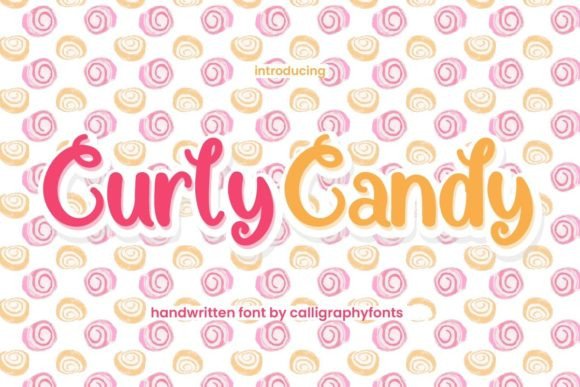
Curly Candy is a distinctive handwritten script font designed with charm, readability, and versatility in mind. Its defining trait—a gentle, consistent curl at the end of nearly every letter—gives it personality without sacrificing clarity. Unlike many decorative scripts that prioritize flair over function, Curly Candy balances visual appeal with practical legibility across sizes and mediums. It’s not just “cute”; it’s intentionally crafted to support real-world creative work—from packaging labels to digital headers—while retaining warmth and approachability.
What Sets Curly Candy Apart
The curl motif isn’t merely ornamental—it’s structural. Each terminal curve reinforces rhythm and flow, helping the eye move smoothly across words. This contributes to better readability in short-form applications like product tags or greeting card headlines, where script fonts often falter. Curly Candy also avoids extreme contrast between thick and thin strokes, reducing visual strain compared to high-contrast scripts. Its x-height is generous, and lowercase letters sit comfortably on the baseline—traits that improve recognition at smaller sizes, especially in print or on-screen thumbnails.
It’s optimized for professional design environments: fully compatible with Adobe Illustrator, Photoshop, InDesign, and CorelDRAW. Glyphs include standard Latin characters, numerals, punctuation, and basic OpenType features (ligatures and stylistic alternates), making it adaptable for both quick mockups and refined production workflows. That compatibility matters—not all playful fonts render consistently across platforms, and some lack full character sets needed for multilingual or technical use.
Fitting Into Real Creative Workflows
Curly Candy excels where tone and context align: bakeries naming seasonal pastries, crafters designing printable gift tags, restaurants updating dessert menus, or indie makers labeling small-batch confections. Its cheerfulness feels authentic—not forced—because it doesn’t rely on exaggerated swashes or excessive bounce. Instead, it uses subtle variation in letter spacing and baseline alignment to suggest spontaneity while remaining predictable enough for branding consistency.
Consider an ice cream shop launching a summer line: using Curly Candy for flavor names (“Lavender Honey Swirl”, “Salted Caramel Crunch”) adds tactile warmth without undermining professionalism. On a wedding invitation suite, it works well for names or short phrases—but less so for full paragraphs or fine-print details like venue addresses. That’s a key distinction: Curly Candy shines in *accent* roles, not body text. It’s a title font, not a paragraph font—and recognizing that boundary helps avoid misapplication.
When Curly Candy Fits Best
- Short, high-impact text: Logo lockups, social media banners, sticker designs, or product name tags where personality matters more than density of information.
- Sweet or handmade contexts: Confectionery brands, artisanal food packaging, craft supply labels, baby shower invites, or boutique stationery—where warmth and approachability are strategic assets.
- Cross-platform projects: When files move between designers using different software, or when clients need editable vector assets, its broad application support reduces compatibility friction.
- Time-sensitive iterations: Because it’s intuitive to pair and scale, Curly Candy speeds up early-stage mockups—especially when testing visual hierarchy against photography or illustration.
Tradeoffs to Acknowledge
No script font is universally suitable—and Curly Candy is no exception. Its cheerful tone can feel incongruous in formal, corporate, or highly technical settings. A law firm’s website header or a medical device manual wouldn’t benefit from its playfulness; the mismatch could undermine credibility. Similarly, long blocks of text—such as blog posts, product descriptions over 50 words, or multi-step instructions—will challenge readability. The curls, while elegant, introduce visual complexity that accumulates with length.
Another consideration is scalability. At very large sizes (e.g., wall murals or signage over 24 inches tall), the fine curl detail may blur or lose definition depending on output resolution and substrate. For such applications, pairing Curly Candy with a clean sans-serif for supporting text—or using it only for focal words—preserves impact without compromising clarity.
Comparing Approaches: Style, Function, and Fit
Handwritten fonts fall along a spectrum—from tightly controlled calligraphic styles to loose, sketch-like lettering. Curly Candy sits near the middle: more structured than freeform brush scripts, but softer and more organic than formal copperplate or Spencerian revivals. That positioning makes it more flexible than ultra-decorative alternatives (which often require careful kerning and limited use cases) and more expressive than minimalist scripts (which can read as sterile or generic).
Compared to system fonts or widely licensed typefaces, Curly Candy offers distinctiveness—valuable when standing out in crowded markets like Etsy shops or local food fairs. Yet unlike custom lettering (hand-drawn per project), it delivers speed and repeatability. The tradeoff? Less bespoke nuance, but greater efficiency and consistency across touchpoints.
For teams collaborating across disciplines—say, a graphic designer, copywriter, and marketing manager—Curly Candy’s predictability helps maintain brand voice. Everyone understands its role: it’s the “smile” in the typography, not the entire conversation.
Practical Pairing Strategies
Effective pairing isn’t about contrast alone—it’s about complementary function. Curly Candy works well with typefaces that provide structure without competing:
- Geometric sans-serifs (e.g., Montserrat, Poppins): Clean lines offset Curly Candy’s curves, creating balance in logos or menu layouts.
- Warm humanist serifs (e.g., Merriweather, Lora): Their gentle stroke modulation echoes Curly Candy’s organic feel without duplicating it—ideal for printed collateral like recipe cards or gift boxes.
- Monospaced fonts (used sparingly): Can add modern contrast in digital contexts, like pairing Curly Candy headlines with code-style ingredient lists on a cooking blog.
Avoid pairing with other high-energy scripts or overly condensed fonts—clutter builds quickly. One playful element is usually enough.
Making the Call: Is Curly Candy Right for Your Project?
Ask three questions before choosing:
- What’s the primary message tone? If warmth, whimsy, or handmade authenticity supports your goal (e.g., “small-batch”, “family recipe”, “hand-poured”), Curly Candy reinforces that. If authority, precision, or neutrality is required, reconsider.
- How much text needs this treatment? If it’s one word, a phrase, or a short headline—yes. If it’s paragraphs, captions, or data-heavy tables—no. Reserve it for moments where attention should linger.
- Where will it appear? Test it in context: on packaging mockups, in email previews, against background photos. Does it hold up at intended size and resolution? Does it remain legible under typical viewing conditions (e.g., phone screens, matte paper, ambient lighting)?
Curly Candy isn’t a replacement for typographic rigor—it’s a tool that earns its place through intentional use. When matched to the right context, it adds resonance without demanding attention. It doesn’t shout; it invites. And in saturated visual landscapes, that quiet confidence often lands more effectively than louder alternatives.
Ultimately, typography serves communication first. Curly Candy succeeds where its aesthetic aligns with purpose—not because it’s trendy or charming in isolation, but because it helps people feel something true about what’s being presented. That alignment, more than any stylistic flourish, is what makes it worth considering.