Breakfast: A Playful Handwritten Script Font
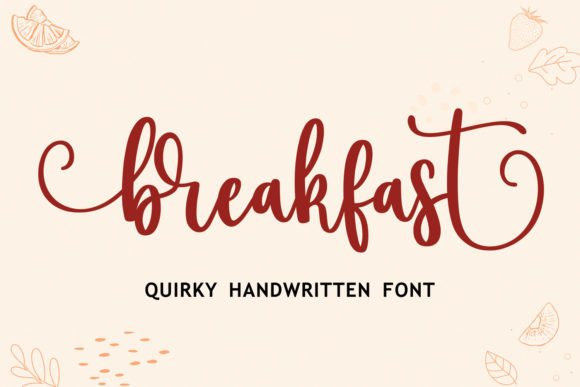
Breakfast isn’t about toast or pancakes—it’s a charming, loopy script font designed to feel like it was written with care and a smile. Its soft curves, gentle loops, and uneven baseline mimic natural handwriting, giving digital designs an authentic, handmade warmth. Unlike rigid display fonts or overly formal calligraphy, Breakfast balances readability with personality—making it especially well-suited for projects where emotion, approachability, and visual softness matter.
Why This Font Resonates Across Creative Roles
Different people reach for Breakfast for different reasons—and that’s by design. A freelance graphic designer might choose it to soften a client’s brand identity for a children’s boutique. A small-batch candle maker could use it on product labels to signal craftsmanship and care. A teacher creating classroom posters might pick Breakfast to make learning materials feel inviting—not intimidating—to young readers. Even a blogger documenting a slow-living lifestyle may lean into its whimsy for quote graphics or newsletter headers.
What ties these uses together isn’t just aesthetics—it’s intention. Breakfast supports communication that feels personal, not polished. It doesn’t shout; it leans in. That makes it useful across contexts where tone carries as much weight as content.
For Beginners: Friendly Entry Point Into Typography
If you’re new to design tools—or even just starting your first Canva project—Breakfast is forgiving. Its letterforms are clear enough to read at medium sizes, and its consistent rhythm helps avoid awkward spacing traps common with more dramatic scripts. You won’t need advanced kerning knowledge to get good results. Try pairing it with a simple sans-serif (like Montserrat or Inter) for contrast: Breakfast for headlines or names, the sans-serif for supporting text. That combo works reliably in invitations, social media posts, or printable planners.
Beginners also appreciate how Breakfast avoids “fussy” details—no sharp terminals or extreme contrast between thick and thin strokes. That means it scales well, prints cleanly, and holds up even when exported at lower resolutions. No tutorials required to start using it meaningfully.
For Crafters & Embroiderers: Where Digital Meets Tactile
Crafters often search for fonts that translate well into physical media—and Breakfast shines here. Its open counters (the enclosed spaces inside letters like a, e, or o) stay legible when stitched at small sizes. Its smooth curves simplify digitizing for embroidery machines, reducing stitch density without sacrificing charm. Think baby onesies with “Sweet Dreams” stitched in Breakfast, or hoop art featuring a handwritten quote like “Good morning, sunshine.”
For paper crafters, Breakfast cuts cleanly on die-cut machines and works beautifully in layered vinyl projects. Its slight irregularity adds authenticity to handmade greeting cards or gift tags—no one mistakes it for mass-produced typography.
Practical Tip for Makers:
- When prepping files for Cricut or Silhouette, convert Breakfast to outlines before uploading—this preserves its shape across devices.
- For embroidery, test stitch a short phrase at your intended size first. Breakfast typically performs best between 18–36 pt in digital formats, which translates to ~1.5–3 inches stitched.
For Educators & Content Creators: Building Connection Through Tone
In education, tone shapes engagement. Breakfast helps educators signal warmth, encouragement, and accessibility—especially in early literacy materials, SEL (social-emotional learning) handouts, or parent newsletters. A worksheet titled “My Kindness Journal” in Breakfast feels gentler than the same title in Arial. It subtly tells students: *This space is safe. You belong here.*
Bloggers and podcasters focused on wellness, parenting, or creative living often use Breakfast to reinforce their voice. It complements photography-heavy layouts and pairs naturally with muted color palettes. Because it’s expressive but not distracting, it supports storytelling without competing with imagery or message.
For Small Business Owners: Branding With Heart
Small businesses—especially those rooted in care, creativity, or community—often struggle to stand out without feeling generic. Breakfast offers differentiation through sincerity. A local bakery might use it on chalkboard-style menus or packaging stickers. A doula or postpartum support service could feature it on business cards or client welcome packets—its softness aligning with empathy-driven messaging.
Crucially, Breakfast works across touchpoints: web headers, Instagram story text overlays, printed receipts, and even email subject lines (when embedded as images). Its flexibility means you don’t need multiple fonts to maintain cohesion—you get consistency *and* character in one package.
What to Consider Before Choosing Breakfast
Like any tool, Breakfast has sweet spots—and limits. It’s not ideal for long paragraphs, legal disclaimers, or data-heavy reports. Its playful nature can clash with highly technical, corporate, or luxury-focused brands aiming for authority over affection.
Ask yourself:
- Is legibility at small sizes critical? If so, reserve Breakfast for headlines, names, or short phrases—not body copy.
- Do you need multilingual support? Breakfast includes standard Latin characters (A–Z, numerals, basic punctuation), but no extended diacritics or Cyrillic/Greek glyphs.
- Are you licensing for commercial use? Always verify the license terms—many versions of Breakfast permit personal and commercial use, but some require attribution or prohibit resale in derivative products.
Its value lies not in universality, but in precision: Breakfast excels when you want to evoke joy, tenderness, nostalgia, or lightheartedness—without irony or detachment.
A Font That Grows With Your Projects
Whether you’re sketching ideas on paper, designing SVG files for cutting machines, preparing embroidery files, or building a Shopify store, Breakfast adapts. It doesn’t demand expertise—but rewards attention to detail. A slight adjustment in letter spacing, a thoughtful color choice, or pairing it with natural textures (linen, watercolor backgrounds, kraft paper) deepens its impact.
Ultimately, Breakfast matters most when it serves your intent—not your toolkit. It’s not about having the “most downloaded” font. It’s about finding the right voice for your message, your audience, and your hands-on process. And sometimes, the most effective design choice is the one that simply feels like home.