Mercy Love: A Handwritten Font with Warmth, Personality, and Purposeful Charm
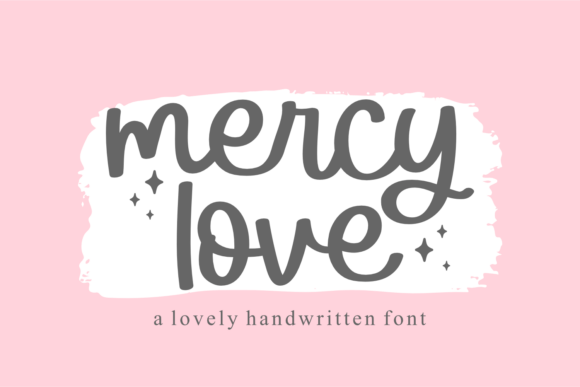
Mercy Love is a carefully crafted handwritten font designed to evoke sincerity, tenderness, and approachability. Unlike many script fonts that prioritize flourish over function—or legibility over feeling—Mercy Love balances expressive curves with consistent spacing and natural rhythm. Its strokes carry subtle variation in weight, mimicking the gentle pressure shifts of ink on paper, while its lowercase letters flow into one another with soft, unhurried connections. This isn’t just decorative handwriting—it’s typography built for emotional resonance.
What Sets Mercy Love Apart From Other Handwritten Fonts
Many handwritten fonts fall into two broad categories: highly formal calligraphic scripts (with sharp angles, dramatic contrast, and structured baselines) and casual, sketch-like fonts (with uneven sizing, erratic spacing, or inconsistent letterforms). Mercy Love occupies a thoughtful middle ground. It avoids the stiffness of formal scripts without slipping into visual chaos. Its baseline remains stable, its x-height generous, and its letter proportions intentionally harmonized—making it more readable at smaller sizes than many peers.
The warmth in Mercy Love comes from deliberate design choices: rounded terminals, open counters (the enclosed spaces inside letters like a, e, or o), and a slight forward lean that suggests movement and invitation—not urgency. These aren’t arbitrary aesthetics; they support legibility and emotional tone simultaneously. For example, in a wedding invitation, Mercy Love conveys intimacy without sacrificing clarity for guests scanning names and dates. In a greeting card, it feels personal—not performative.
Where Mercy Love Excels—and Where It Has Limits
Mercy Love shines in contexts where authenticity and emotional connection matter more than neutrality or authority. It’s especially effective for:
- Wedding stationery—especially for couples seeking a relaxed, heartfelt aesthetic rather than traditional opulence;
- Greeting cards and gift tags meant to feel hand-written by the sender;
- Branding for small businesses centered on care, wellness, or creativity (e.g., a boutique florist, a mindfulness coach, or an independent baker);
- Social media graphics featuring short, meaningful quotes—particularly those about love, kindness, or reflection;
- Personal projects like memory books, journal covers, or framed affirmations.
That said, Mercy Love is not optimized for every use. It lacks extended language support in many versions, so multilingual layouts may require fallback fonts. It also doesn’t include extensive OpenType features like stylistic alternates or contextual ligatures—so designers seeking fine-grained typographic control may need to pair it thoughtfully or supplement with other tools. And while its readability holds up well at 14–18 pt in print, using Mercy Love for body text below 12 pt—or for long-form digital reading—can strain clarity. It’s a voice, not a narrator.
How Mercy Love Compares With Broader Handwritten Categories
When evaluating handwritten fonts, it helps to consider three practical dimensions: expressiveness, functionality, and adaptability.
Expressiveness refers to how strongly a font communicates mood or intention. Mercy Love scores high here—its curves and spacing consistently signal warmth and ease. Some alternatives offer more drama (e.g., fonts with extreme contrast or exaggerated swashes) or more quirk (e.g., irregular baselines or childlike proportions). Those can work beautifully in specific contexts—but they often narrow their range of appropriate applications.
Functionality covers technical considerations: character set completeness, file format options (OTF vs. TTF), licensing clarity, and rendering consistency across devices. Mercy Love is typically distributed as a well-structured OTF with standard Latin characters and common punctuation. It performs reliably in design software like Adobe Illustrator or Figma, and renders cleanly on most modern browsers when embedded via @font-face—though web use requires attention to licensing terms and loading performance.
Adaptability speaks to how easily a font integrates into broader design systems. Mercy Love pairs well with clean, neutral sans-serifs (e.g., Inter, Lato, or Montserrat) for contrast without competition. Its organic flow creates balance against geometric structure—ideal for headings paired with functional body text. It’s less suited as a sole font in minimalist or corporate identities where restraint and scalability are priorities.
Realistic Use Cases: When to Choose Mercy Love—and When to Look Elsewhere
Imagine designing a set of thank-you cards for a baby shower. The goal is to convey genuine appreciation—not formality or distance. Mercy Love works naturally here: its soft curves echo the tenderness of the occasion, and its legibility ensures names and messages stay clear even when printed on textured cardstock. Pair it with a light gray sans-serif for addresses or details, and the hierarchy feels intuitive, not forced.
Now consider a nonprofit’s annual report—meant to communicate impact, transparency, and accountability. While a single headline in Mercy Love could humanize a section opener (“Stories of Hope”), relying on it for data tables, captions, or lengthy narratives would undermine credibility and accessibility. In that case, a versatile, highly legible serif or sans-serif serves the mission better.
Another scenario: a small café launching branded merchandise. Mercy Love on a ceramic mug or tote bag reinforces a cozy, handmade vibe. But if the same café also needs outdoor signage visible from a distance—or menu boards updated weekly in a digital kiosk—Mercy Love’s delicate forms may not scale effectively. A bolder, more robust display font would be more practical for those touchpoints, even if Mercy Love remains the heart of the brand’s voice.
Making an Informed Choice
Choosing a font like Mercy Love isn’t about finding the “best” option—it’s about matching typographic qualities to communicative goals. Ask yourself:
- What emotion or impression do I want this text to carry? If warmth, sincerity, or gentleness are central, Mercy Love delivers with consistency.
- At what size and in what medium will it appear? Test it in context—not just in a font menu. Print samples, preview on mobile, and check contrast ratios if accessibility matters.
- Does it coexist well with other typefaces I’m already using? Mercy Love gains strength through contrast, not isolation. Its effectiveness grows when supported by clear, functional companions.
- What are my technical constraints? Licensing, language needs, and file compatibility aren’t afterthoughts—they shape feasibility before design begins.
Mercy Love won’t solve every typographic challenge, nor should it. Its value lies in its specificity: it’s a tool shaped for moments where people need to feel seen, welcomed, or gently reminded of connection. Used with awareness—not just affection—it becomes more than a font. It becomes part of the message itself.
For designers, marketers, and creators weighing options, Mercy Love offers a reliable, emotionally intelligent choice when the goal is tenderness, not trendiness—and when personality must serve purpose, not overshadow it.