Blush Kiss: A Strategic Choice for Romantic and Playful Typography
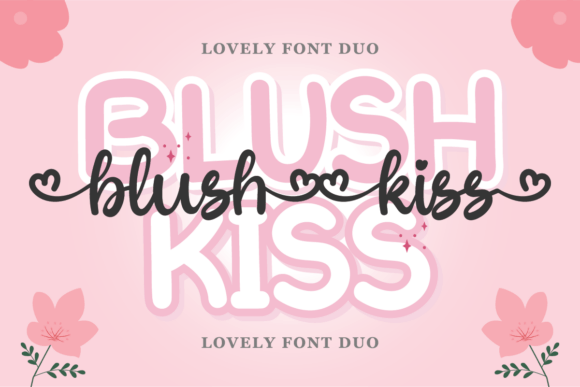
Typography isn’t just about letters—it’s about tone, intention, and resonance. When your message hinges on warmth, sincerity, or lighthearted charm—especially in emotionally charged contexts like weddings, brand storytelling, or seasonal campaigns—the right font duo can reinforce meaning before a single word is read. Blush Kiss stands out not as a decorative flourish, but as a purpose-built typographic system: one that pairs a confident, rounded sans-serif with an expressive, heart-embellished script. Its design logic is intentional—contrast without conflict, playfulness grounded in legibility, romance anchored in craft.
Why Blush Kiss Fits Real-World Goals—Not Just Aesthetic Preferences
Choosing Blush Kiss isn’t about chasing trendiness. It’s about aligning visual language with strategic outcomes. For small business owners launching a bridal boutique, the script’s delicate swashes signal intimacy and care—qualities customers associate with personalized service. Meanwhile, the sans-serif provides structural clarity for pricing, policies, or contact details. That duality supports both emotional connection *and* functional communication.
Freelancers and designers often underestimate how much typography influences client perception before a proposal is even opened. A pitch deck using Blush Kiss conveys creative confidence *and* attention to nuance—valuable when positioning yourself against competitors who default to overused scripts or sterile system fonts. Educators crafting Valentine’s-themed classroom materials find that students engage more readily with text that feels human and inviting—not rigid or corporate. In each case, Blush Kiss serves as a quiet amplifier of intent, not a distraction from it.
When Context Makes All the Difference
Blush Kiss excels where emotional resonance matters—but only when applied with discipline. Its script shines in headlines, monograms, or short quotes (e.g., “Forever Starts Here” on a wedding suite), but loses effectiveness in dense body copy or fine-print legal disclaimers. The sans-serif, by contrast, handles longer passages well—ideal for event timelines, product descriptions, or social media captions where readability trumps ornamentation.
Consider timing and platform. A Canva-designed Instagram Story using Blush Kiss script for a limited-time offer (“24 Hours Only ❤️”) gains memorability through rhythm and warmth. But the same script in a desktop email newsletter header may render inconsistently across devices—especially if fallbacks aren’t planned. That’s why compatibility with Adobe Illustrator, Photoshop, and Canva matters less than *how* you use it: embedding outlines for print, testing line spacing at scale, and verifying contrast ratios for accessibility.
Practical Planning Tips for Intentional Use
- Start with hierarchy, not aesthetics. Map your content structure first: what needs emphasis? What must be scannable? Let that guide which weight or style of Blush Kiss goes where—not the other way around.
- Test before committing. Print a sample invitation at actual size. View a social post on both iOS and Android. Check how the heart swashes behave at 14pt versus 48pt. Small details impact perceived professionalism more than you might expect.
- Pair thoughtfully—not automatically. While Blush Kiss includes both fonts, avoid using the script for every heading and the sans for every subhead just because they’re bundled. Sometimes a clean secondary sans-serif (like Inter or Poppins) creates sharper contrast and improves long-form readability.
- Account for production constraints. If you’re ordering foil-stamped stationery, confirm with your printer whether the script’s thin strokes and delicate hearts translate reliably at small sizes. Some embellishments require minimum line weights.
Risks of Using Blush Kiss Without Clear Intent
Without grounding in goals, Blush Kiss can unintentionally dilute credibility. Overusing the script—say, across an entire website navigation or in a formal business proposal—can suggest informality where authority is expected. Similarly, applying it to brands with serious missions (e.g., financial advising, healthcare advocacy) risks misalignment unless carefully contextualized (e.g., a wellness coach using it only in nurturing blog headers—not clinical intake forms).
There’s also a subtle operational risk: assuming font choice alone solves communication challenges. A beautifully typeset menu won’t compensate for unclear pricing or confusing service tiers. Blush Kiss enhances clarity—it doesn’t replace it. When teams skip messaging strategy and jump straight to design tools, they often end up revising layouts repeatedly, not because the font is wrong, but because the underlying structure wasn’t defined.
Long-Term Value Beyond the First Project
Investing time in learning Blush Kiss pays dividends beyond individual deliverables. Its dual nature trains your eye for typographic contrast—a skill that transfers directly to selecting fonts for future projects, evaluating client assets, or auditing brand consistency. Designers who master its rhythm and restraint develop stronger instincts for when to lead with emotion versus efficiency.
For entrepreneurs building recognizable brands, consistent use of Blush Kiss across touchpoints—invitations, thank-you cards, digital ads, even packaging—creates subtle continuity. Customers begin associating those curves and hearts with your voice, not just the occasion. That kind of recognition compounds over time, especially when paired with thoughtful color palettes and layout discipline.
Strategic Observations for Decision-Makers
- It’s not for everything—and that’s its strength. Limiting Blush Kiss to high-impact moments (e.g., logos, hero banners, signature phrases) increases its associative power. Scarcity builds significance.
- Legibility isn’t optional—it’s non-negotiable. The script’s charm depends on context. At 18px on mobile, test whether “forever” reads clearly—or collapses into ambiguity. Adjust tracking, size, or weight before compromising clarity.
- Think beyond the download. Licensing terms matter. Verify whether your intended use (e.g., client work, merchandise, SaaS interface) falls within the included license. Some creators assume “personal use” covers freelance deliverables—only to face compliance issues later.
- Design systems evolve. If you adopt Blush Kiss as part of a broader brand system, document usage rules: when to use all-caps versus sentence case, minimum sizes, acceptable color combinations, and prohibited applications (e.g., no reversed-out script on busy photos).
Ultimately, Blush Kiss works best when treated as a tool—not a shortcut. It invites intentionality: choosing where softness serves your message, where boldness adds clarity, and where restraint honors your audience’s attention. That mindset extends far beyond typography. It reflects how skilled professionals approach any creative decision—not asking “What looks nice?” but “What helps people understand, remember, and act?”
Whether you’re finalizing a wedding brand guide, refreshing a small business’s social presence, or designing educational resources with emotional intelligence, Blush Kiss offers more than visual appeal. It offers a framework for balancing heart and precision—two qualities that, when aligned, drive better decisions, clearer communication, and more meaningful results.