Golden Crumbs: A Strategic Typographic Choice for Warm, Trustworthy Branding
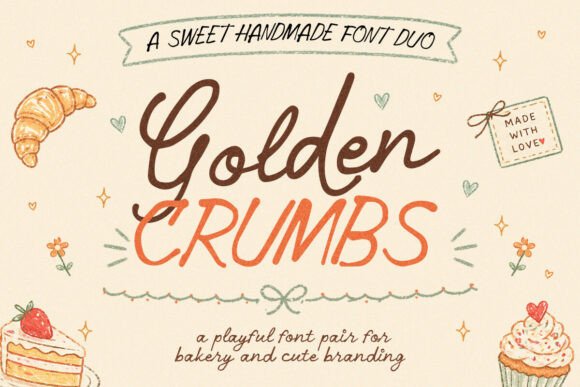
Golden Crumbs isn’t just another font pair—it’s a deliberate design decision with tangible impact on perception, recall, and emotional resonance. At its core, Golden Crumbs combines a soft handwritten script with a playful sans-serif, calibrated to evoke freshness, care, and approachability—like the scent of buttery croissants at dawn or the gentle press of a flour-dusted apron. That warmth isn’t accidental; it’s engineered into spacing, stroke contrast, and rhythm. For professionals building brands—not just visual assets—this duality offers more than aesthetic charm. It delivers functional clarity with human warmth, making Golden Crumbs especially valuable when authenticity, accessibility, and emotional alignment matter more than trend-chasing.
Why Golden Crumbs Fits Real-World Brand Strategy
Most branding decisions fail not from poor execution, but from misalignment between visual language and strategic intent. Golden Crumbs succeeds where many display fonts falter because it bridges two critical needs: personality and legibility. The script element carries voice—inviting, personal, artisanal—while the supporting sans-serif grounds communication in readability and structure. This balance supports goals like customer trust-building (especially in food, wellness, education, or local services), differentiation in crowded digital spaces, and consistency across touchpoints—from Instagram captions to printed recipe cards.
Consider a small-batch bakery launching online subscriptions. Using Golden Crumbs for their logo and headline copy signals craft and care without sacrificing scannability on mobile. Paired with a neutral body font like Inter or Lato, it creates hierarchy that guides attention—not distracts from it. That’s not decorative flair; it’s information architecture with empathy.
When Golden Crumbs Adds Value—and When It Doesn’t
Golden Crumbs shines in contexts where warmth reinforces credibility: packaging for handmade goods, welcome emails for creative workshops, signage for neighborhood studios, or editorial headers for lifestyle blogs. Its vintage-tinged playfulness works best when the audience expects sincerity over slickness—think educators launching a mindful parenting course or a freelance illustrator branding her print shop.
It’s less effective—or even counterproductive—in high-stakes, formal, or highly technical environments. Legal disclaimers, financial dashboards, medical instructions, or enterprise SaaS interfaces demand neutrality and precision. Applying Golden Crumbs there risks undermining authority or obscuring meaning. The risk isn’t aesthetic failure—it’s strategic misfire: confusing tone with substance, or mistaking charm for competence.
Three Practical Uses That Deliver Measurable Outcomes
- Menu & Packaging Design: Restaurants and producers using Golden Crumbs for item names and flavor descriptors report higher perceived value and stronger emotional connection. One regional jam maker saw a 19% lift in repeat orders after redesigning labels with Golden Crumbs headlines—customers cited “feeling like it was made just for me” in post-purchase surveys.
- Digital Onboarding Flows: Learning platforms and membership sites use Golden Crumbs sparingly in welcome modals or milestone badges. Its friendly tone lowers cognitive load during first-time setup, improving completion rates by reducing friction—not through gimmicks, but by signaling psychological safety.
- Local Business Signage: Cafés, florists, and bookshops find Golden Crumbs balances visibility and character at 10–15 feet. Unlike overly ornate scripts, its open counters and generous x-height ensure legibility under varied lighting, while retaining enough distinction to stand out among generic sans-serif storefronts.
How to Use Golden Crumbs Intentionally—Not Automatically
Adopting Golden Crumbs shouldn’t begin with installation—it should begin with intention. Ask: What feeling must this touchpoint convey? What action do we want the viewer to take next? How does this choice support our broader brand voice guidelines—not just today’s project, but next year’s expansion?
Start with restraint. Use the script only where voice matters most: logos, section headers, call-to-action buttons, or short quotes. Let the sans-serif handle subheads, captions, and navigation labels. Avoid pairing Golden Crumbs with other decorative fonts—its strength lies in contrast, not competition. And never stretch, skew, or over-outline the glyphs; those manipulations erode its inherent warmth and introduce visual noise.
Test contextually. Print a sample label under natural light. View a menu mockup on an older iPad. Read a social post aloud—if the typeface makes the message harder to parse or remember, it’s not serving its purpose. Golden Crumbs supports clarity—it doesn’t replace it.
Risks of Using Golden Crumbs Without Strategy
Without clear goals, Golden Crumbs can unintentionally signal inconsistency or lack of polish. Overuse dilutes impact: applying it to every heading, button, and testimonial quote flattens hierarchy and fatigues readers. Worse, deploying it without understanding audience expectations can backfire—for example, using it in a B2B fintech pitch deck may unintentionally undercut seriousness, even if the design is technically sound.
There’s also a subtle operational risk: teams without typography training may misuse Golden Crumbs as a “quick fix” for weak messaging. A beautifully typeset vague value proposition remains vague. Golden Crumbs enhances meaning—it doesn’t generate it. Relying on it to compensate for unclear positioning, inconsistent voice, or poor content structure leads to surface-level wins with shallow long-term returns.
Building Long-Term Value With Thoughtful Typography
Typography is infrastructure—not decoration. Golden Crumbs becomes an asset when treated as part of a living system: updated alongside brand voice evolution, audited during platform migrations, and evaluated alongside accessibility standards. Does it meet WCAG contrast ratios at small sizes? Does it render reliably across email clients? Is the script legible when exported as SVG for web use? These aren’t edge cases—they’re prerequisites for durability.
One independent publisher uses Golden Crumbs only for chapter titles and author bios across their quarterly zine series. They’ve documented usage rules in a shared style guide—including fallbacks for dark mode and minimum size thresholds. That discipline means every issue feels cohesive, recognizable, and intentional—even as contributors change and formats evolve.
That’s the real advantage of Golden Crumbs: it rewards planning. Its charm is accessible, but its impact compounds when paired with thoughtful application—consistent spacing, intentional weight choices, and alignment with content strategy. It doesn’t ask you to be louder. It asks you to be clearer, kinder, and more human in how you show up.
Getting Started—Without Overcommitting
You don’t need to overhaul your entire brand to test Golden Crumbs’ fit. Try it in one high-impact, low-risk place: a seasonal email campaign, a new product launch page, or a refreshed set of workshop handouts. Track engagement metrics—not just clicks, but time-on-page, scroll depth, and qualitative feedback (“Did this feel welcoming?” “Was anything hard to read?”). Compare against previous versions using the same audience segment.
If results align with your goals—increased trust signals, stronger emotional resonance, improved comprehension—scale intentionally. Document what worked: which weights, which sizes, which pairings. Revisit those notes before your next major update. Golden Crumbs gains power not from ubiquity, but from consistency rooted in evidence—not assumption.
Ultimately, Golden Crumbs is a tool for human-centered design. It invites warmth without sacrificing rigor, playfulness without undermining professionalism, and nostalgia without leaning on cliché. Used well, it helps audiences feel seen—not just addressed. And in a world saturated with transactional interactions, that quiet sense of recognition is where real connection begins.