Are You Kidding Me: A Playful Handwritten Font with Purpose
“Are You Kidding Me” isn’t just a rhetorical question—it’s a distinctive handwritten font designed to carry personality, warmth, and expressive energy. Unlike many script fonts that prioritize elegance or formality, Are You Kidding Me leans into spontaneity. Its rounded, slightly irregular letterforms mimic the natural rhythm of real handwriting—think pen-on-paper imperfections, subtle inconsistencies in stroke weight, and gentle variations in baseline alignment. Yet it remains highly legible, even at moderate sizes, thanks to intentional spacing and clear character distinction.
What Makes Are You Kidding Me Stand Out
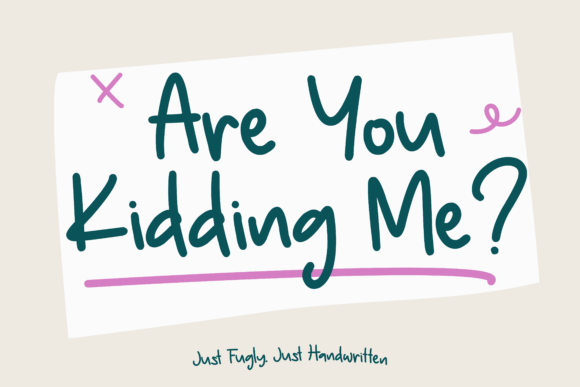
The font’s charm lies in its expressive confidence—not polished perfection, but thoughtful authenticity. The uppercase “K,” for example, features an exaggerated diagonal stroke that adds visual punch without sacrificing readability. The question mark is oversized and bouncy, reinforcing the font’s conversational tone. These aren’t arbitrary flourishes; they’re functional design choices that support voice and mood. Even the lowercase “a” and “g” use open, friendly shapes that invite engagement rather than distance.
Decorative elements—like the optional pink underline or hand-drawn doodle accents—aren’t afterthoughts. They’re built-in tools that extend the font’s expressive range. Used sparingly, they reinforce light-hearted messaging without overwhelming the text. This intentional layering gives designers flexibility: you can deploy the base font alone for clean impact, or add accents for extra whimsy in social media graphics, event invitations, or product packaging aimed at younger or creatively inclined audiences.
How It Fits Within the Broader Landscape of Handwritten Fonts
Handwritten fonts fall across a wide spectrum—from ultra-refined calligraphic scripts to rough, sketch-style lettering. Are You Kidding Me occupies a deliberate middle ground: more structured than chaotic doodle fonts, yet less formal than elegant brush scripts. That positioning makes it especially useful when you need personality *and* clarity—like labeling a craft beer can, designing a boutique newsletter header, or crafting Instagram carousel text that must land quickly and memorably.
Compared to tightly kerned, high-contrast scripts (often used for luxury branding), Are You Kidding Me trades sophistication for approachability. It won’t convey heritage or exclusivity—but it *will* signal friendliness, creativity, and a relaxed point of view. Conversely, it’s more legible and consistent than ultra-loose, sketch-based fonts where letters might vary wildly between instances—making it easier to use across multiple platforms without manual adjustments.
Strengths in Real-World Use Cases
Are You Kidding Me excels where tone matters as much as information. In social media, short-form copy benefits from its inherent energy: a caption like “New flavors just dropped—are you kidding me?” gains immediacy and relatability through the font’s expressive shapes. Similarly, educational content aimed at teens or young adults—think workshop handouts or digital learning modules—can feel less intimidating and more inviting when key headings use this typeface.
Brands with playful, inclusive, or DIY-oriented identities often find it a strong fit. A small-batch candle company, for instance, might use Are You Kidding Me for product name tags (“Lemon & Daydream”) while pairing it with a neutral sans-serif for ingredients and safety info. That contrast creates visual hierarchy *and* reinforces brand voice: warm, human, and unpretentious.
Tradeoffs and Practical Considerations
No font works universally—and Are You Kidding Me has clear boundaries. Its expressive nature means it’s not ideal for long paragraphs, body text, or dense informational layouts. Line spacing, character width variation, and dynamic stroke weights all contribute to its charm but reduce scanning efficiency. For anything beyond headlines, pull quotes, or short labels, pairing it with a highly legible companion font is essential.
It also carries strong tonal associations. If your project requires authority, tradition, or technical precision—say, a legal document, academic journal, or enterprise software interface—this font will likely undermine the intended message. Likewise, in contexts where cultural nuance matters deeply, its Western, informal inflection may not translate well across global audiences without careful adaptation.
Technical considerations matter too. While most versions include standard Latin characters and common punctuation, extended language support (e.g., Central/Eastern European diacritics or Cyrillic) varies by vendor. Always verify glyph coverage before committing to large-scale implementation—especially if multilingual use is planned.
When to Choose Are You Kidding Me—and When to Look Elsewhere
Choose Are You Kidding Me when your priority is injecting warmth, humor, or casual confidence into a limited set of typographic elements. It shines in branding moments that benefit from human-scale expression: logo lockups (as a secondary wordmark), social banners, email subject lines, merch designs, or animated UI microcopy. Its strength is emotional resonance—not functional neutrality.
Look elsewhere if you need versatility across typographic roles (e.g., one font family covering display, subhead, and body text), require strict accessibility compliance for extended reading, or are working within a brand system that values restraint, timelessness, or cross-cultural neutrality. In those cases, a well-designed variable sans-serif—or even a more restrained handwritten option with tighter metrics and fewer stylistic extremes—may serve better.
Making an Informed Choice
Evaluating a font like Are You Kidding Me isn’t about finding the “best” option—it’s about matching expressive intent with practical constraints. Ask yourself: What emotion or impression do readers need to take away from this text? How much space does it occupy in the layout? Who is seeing it, and under what conditions? Does consistency across devices and platforms matter more than stylistic flair?
Testing matters more than theory. Try setting your actual headline or call-to-action in Are You Kidding Me alongside two alternatives—one more neutral, one more decorative—and review them side-by-side on both desktop and mobile. Notice where your eye lingers, where meaning feels clearest, and where tone aligns—or clashes—with surrounding visuals.
You’ll also want to consider licensing. Some versions of Are You Kidding Me are offered under personal-use-only terms, while others permit commercial deployment, web embedding, or app integration. Always confirm usage rights match your project scope—especially for client work or products with distribution plans.
A Final Note on Authenticity
The tagline “Just Fugly. Just Handwritten” isn’t self-deprecation—it’s a design philosophy. Are You Kidding Me embraces the idea that imperfection, when intentional, builds connection. It doesn’t try to hide the hand behind the lettering; it highlights it. That honesty resonates in a digital landscape increasingly saturated with algorithmically smoothed, homogenized visuals.
That said, authenticity shouldn’t override function. The right font choice balances expressive truth with user-centered clarity. Are You Kidding Me delivers on the former with unmistakable character—just be sure the latter stays in focus as you decide where and how to use it.