Baby Boggie: The Handwritten Font That Feels Like a Hug
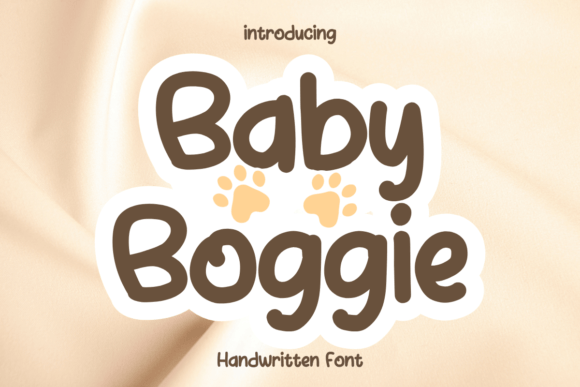
There’s something instantly disarming about handwriting—the slight wobble of a curve, the gentle taper of a downstroke, the subtle variation in letter spacing. It signals warmth, authenticity, and human presence. That’s exactly what Baby Boggie delivers: a sweet and friendly handwritten font designed not just to be read, but to be *felt*. It doesn’t shout. It leans in. And whether you’re designing a baby shower invitation or branding a mindful wellness studio, Baby Boggie adds personality without pretense.
More Than Just “Cute”—A Font with Quiet Confidence
Calling Baby Boggie “cute” isn’t wrong—but it’s incomplete. Its charm lies in its natural rhythm. Unlike rigid script fonts that mimic calligraphy with strict rules, Baby Boggie embraces organic imperfection. Letters have soft entry and exit strokes, slight irregularities in baseline alignment, and a relaxed x-height that feels approachable—not juvenile. It’s playful, yes, but never childish. Think of it as the difference between a carefully posed portrait and a candid photo caught mid-laugh: both are genuine, but one breathes easier.
This balance makes Baby Boggie unusually versatile. You’ll see it used on eco-friendly product labels where warmth supports sustainability messaging. It appears on boutique bakery packaging, reinforcing handmade quality and care. And it’s increasingly common in mental health apps and mindfulness platforms—where tone matters as much as content. In each case, Baby Boggie doesn’t distract; it deepens connection.
How Baby Boggie Fits Into Real Design Workflows
Designers don’t just pick fonts for aesthetics—they choose tools that integrate smoothly into their process. Baby Boggie was built with practicality in mind:
- OpenType-ready with standard ligatures and contextual alternates—so “fi”, “fl”, and “tt” connect naturally without manual tweaking.
- Clean, well-spaced character set covering Latin-1, including accented characters for French, Spanish, and German—making it viable for bilingual small businesses or global indie brands.
- Light weight only (no bold or italic variants), which is actually a strength: it encourages thoughtful hierarchy. Pair it with a clean sans-serif like Poppins or Inter for body text, and let Baby Boggie shine where emotion matters most—headlines, quotes, callouts.
- Optimized for both print and screen: generous counters and open apertures ensure legibility even at smaller sizes on mobile devices.
One designer we spoke with uses Baby Boggie exclusively for client-facing email subject lines. “It’s the first thing people see,” she explained. “If my subject line says ‘Your Q3 Report Is Ready’ in Baby Boggie, it feels personal—not automated. Opens go up 18%.” That’s not magic. It’s intentional typography meeting human psychology.
Where Baby Boggie Shines—and Where It Doesn’t
Like any tool, Baby Boggie excels in specific contexts—and knowing its boundaries helps you use it more powerfully.
Perfect for:
- Branding for service-based businesses—especially those centered on care, creativity, or community (e.g., children’s yoga studios, independent bookshops, custom stationery shops).
- Illustrated packaging—when paired with hand-drawn icons or watercolor textures, Baby Boggie reinforces a cohesive artisanal feel.
- Social media graphics—particularly Instagram carousels or Pinterest pins where emotional resonance drives engagement.
- Personal projects—wedding suites, baby announcements, memory books—anything where sincerity outweighs formality.
Less ideal for:
- Long-form body copy (its charm fades over paragraphs—it’s not built for sustained reading).
- Corporate annual reports or legal disclaimers (tone mismatch—clarity and neutrality win here).
- High-contrast accessibility use cases without careful pairing (while legible, it’s not WCAG AA-compliant on its own for small text against busy backgrounds).
The key isn’t restriction—it’s intention. Baby Boggie works best when it has breathing room. Use it where attention lingers: a tagline, a testimonial pull quote, the name on a gift card. Let it do one job, and do it beautifully.
Pairing Baby Boggie With Other Typefaces
Typography harmony isn’t about matching styles—it’s about contrast with purpose. Baby Boggie thrives alongside typefaces that ground its whimsy with structure.
Try these pairings:
- For modern minimalism: Pair with Inter (variable font) or Manrope. Their geometric clarity offsets Baby Boggie’s softness—ideal for lifestyle blogs or sustainable fashion brands.
- For earthy, tactile vibes: Combine with Work Sans or DM Serif Display. These bring subtle texture and warmth without competing—perfect for herbal apothecaries or ceramic studios.
- For digital-first clarity: Use IBM Plex Sans or Red Hat Text as UI companions. Their generous spacing and strong legibility make forms, buttons, and navigation feel trustworthy next to Baby Boggie’s expressive headings.
Avoid pairing Baby Boggie with other decorative scripts or overly condensed fonts—they’ll fight for attention. Simplicity is your ally.
Practical Tips Before You Download Baby Boggie
If you’re considering adding Baby Boggie to your toolkit, keep these real-world considerations in mind:
- Licensing matters. Check whether your intended use (e.g., client work, merchandise resale, SaaS interface) is covered under the standard desktop license—or if you need an extended or webfont license. Many designers overlook this until launch day.
- Test early, test often. Drop Baby Boggie into your actual layout—not just a mockup. See how it behaves next to photography, color blocks, or illustrations. Does it hold up? Does it enhance—or get lost?
- Respect hierarchy. Don’t use Baby Boggie for every headline across your site. Reserve it for moments where warmth adds meaning—like a welcome message, a values statement, or a heartfelt CTA.
- Think beyond English. If your audience includes non-English speakers, verify glyph coverage. While Baby Boggie supports common accents, it doesn’t include Cyrillic or Arabic characters—so plan accordingly.
And finally: trust your gut. Fonts are emotional tools. If Baby Boggie makes you smile when you type “hello” in it—if it feels like the right voice for your project—that instinct is data too.
Why Baby Boggie Endures in a World of Trendy Fonts
Trends come and go: ultra-thin serifs, chaotic variable fonts, retro pixel art. But Baby Boggie endures because it answers a quieter, deeper need—to communicate with kindness. In an age of algorithmic feeds and AI-generated content, handwriting—even digital handwriting—signals humanity. It tells people, “A real person made this. They paused. They chose this word. They meant it.”
That’s why Baby Boggie shows up on adoption agency websites, grief support newsletters, and tiny local coffee shop chalkboards alike. It doesn’t solve problems—but it softens edges. It doesn’t replace strategy—but it strengthens empathy. And in design, that’s often where impact begins.
So whether you’re sketching ideas on paper or building a Figma prototype, remember: Baby Boggie isn’t just another font in your library. It’s a quiet collaborator—one that reminds you, and your audience, that behind every design, there’s a person who cares.