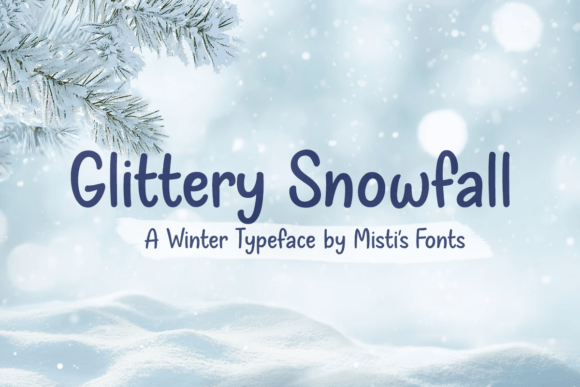
Glittery Snowfall: A Playful Handwritten Font
Glittery Snowfall isn’t just another holiday font—it’s a versatile, hand-drawn typeface with quiet confidence and subtle charm. Its letters flow like ink sketched on frosted glass: slightly uneven, warmly irregular, and unmistakably human. There’s no forced sparkle or over-the-top ornamentation—just delicate texture, gentle contrast, and a soft rhythm that invites attention without demanding it. That balance—playful yet legible, festive yet functional—is what makes Glittery Snowfall genuinely useful across real-world design tasks.
Why It Works Where Other Whimsical Fonts Don’t
Many handwritten fonts sacrifice clarity for character. Glittery Snowfall avoids that trap. Its x-height is generous, spacing is thoughtfully open, and letterforms maintain consistent weight distribution—even at small sizes. That means it holds up in print and on screen, whether you’re labeling a jar of homemade jam or overlaying text on an Instagram Story with busy background imagery. Unlike overly stylized scripts that blur into abstraction, Glittery Snowfall stays readable while still feeling personal and intentional.
It also scales well. At 24pt, it brings warmth to a workshop flyer. At 80pt, it anchors a holiday market banner with presence—not noise. And because its baseline has slight organic variation (not rigid alignment), it avoids the sterile uniformity that can make digital typography feel cold or automated.
Creative Uses Beyond the Obvious
Yes, Glittery Snowfall shines during December—it’s ideal for greeting cards, gift tags, and seasonal email headers. But its utility stretches much further. Consider these grounded, audience-tested applications:
- Educators use it for classroom posters and student award certificates—its friendly tone reduces intimidation without sacrificing professionalism.
- Small business owners apply it to product labels (especially for artisanal goods like candles, soaps, or baked treats) where handmade authenticity matters more than corporate polish.
- Bloggers and content creators pair it with clean sans-serifs (like Inter or Lato) for blog headers or Pinterest pins—creating visual hierarchy without visual competition.
- Nonprofits and community groups incorporate it into event flyers for local markets, storytime sessions, or neighborhood cleanups—signaling approachability and care.
One freelance illustrator uses Glittery Snowfall exclusively for client project titles in her portfolio thumbnails—not as body text, but as a consistent visual signature. It doesn’t shout “look at me,” but it does say, “this was made with attention.” That kind of subtle branding builds recognition over time, not just seasonal impact.
Pairing It Thoughtfully
Glittery Snowfall thrives when paired intentionally—not just contrasted for effect, but supported for function. Avoid pairing it with other decorative fonts; instead, choose one strong neutral companion. A well-chosen sans-serif (with open counters and modest stroke contrast) creates breathing room and grounds the whimsy. For print projects, try it with Source Sans Pro or Open Sans. For web use, system fonts like Segoe UI or Helvetica Neue work reliably across devices.
Color matters, too. While golds and deep reds lean into holiday expectations, Glittery Snowfall reads beautifully in muted sage, warm charcoal, or even soft terracotta. One bakery owner tested three color versions of her holiday menu header: classic crimson, forest green, and oatmeal beige. Customers consistently rated the oatmeal version as “most inviting”—proof that restraint often amplifies personality better than saturation.
Practical Tips for Consistent Results
When using Glittery Snowfall across multiple platforms or touchpoints, consistency starts with intention—not automation. Here’s how to keep it effective:
- Limit usage to one primary role per project. If it’s your headline font, don’t also use it for captions or buttons. Let it own one job well.
- Test legibility early. Preview text at actual size and context—on mobile screens, printed at 300dpi, or projected in dim lighting. Adjust tracking if letters feel cramped, especially in all-caps settings.
- Respect its rhythm. Don’t force tight kerning or stretch it horizontally. Its charm lives in natural spacing—so let it breathe.
- Use OpenType features sparingly—but purposefully. If your software supports stylistic alternates, swap out a single repeated letter (like double “l” in “holiday”) for visual interest—not every instance.
One educator shared how she standardized Glittery Snowfall across her school’s literacy program: same font, same size (36pt), same line height (1.3), always in navy on off-white paper. No variations. Students began recognizing materials instantly—not because they read the title first, but because the *feel* of the text signaled “this is ours.” That’s the power of disciplined application.
Adapting for Different Audiences and Goals
A wedding planner might use Glittery Snowfall for save-the-date illustrations—but only where illustration already dominates. She avoids it in legal disclaimers or vendor contracts, reserving it for moments that benefit from emotional resonance. A science communicator uses it in children’s activity sheets (e.g., “Find the snowflake pattern!”) but switches to monospace for code snippets or data tables. The font doesn’t change—the context does.
For social media, consider platform constraints: Instagram allows limited font control, so designers embed Glittery Snowfall in static image assets. On websites, use it as a @font-face for headings only—not paragraphs—to preserve performance and accessibility. Always provide fallbacks and ensure sufficient color contrast (at least 4.5:1 against background).
What ties these varied uses together isn’t the font itself—but how deliberately it’s applied. Glittery Snowfall works because it responds to thoughtful decisions, not because it solves every problem automatically.
A Tool, Not a Trend
Trends fade. Tools endure when they serve real needs without demanding constant reinterpretation. Glittery Snowfall endures because it meets people where they are: designers balancing speed and soul, educators building inclusive environments, entrepreneurs communicating values before words are read. It doesn’t replace strategy—it supports it. It won’t fix weak messaging, but it can make clear ideas feel more human.
So download it. Test it on a real file—not a mockup. Try it with your brand’s existing palette. See how it behaves next to your most-used body font. Then decide—not based on what’s popular, but on what feels true to your voice, your audience, and the work you actually do.