My Sweety: Where Handwritten Elegance Meets Digital Versatility
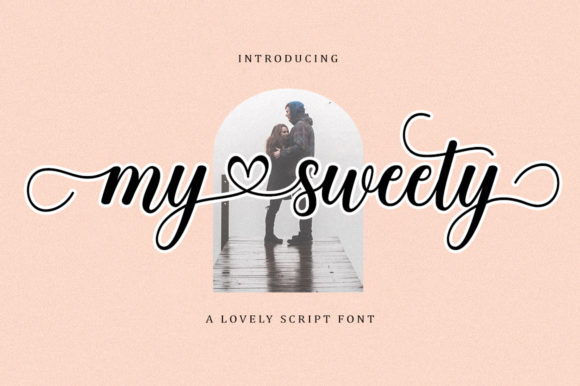
Typography is rarely just about legibility—it’s about resonance. A font carries tone, intention, and emotional texture before a single word is read. Among contemporary handwritten typefaces, My Sweety stands apart not through exaggeration or trend-chasing, but through quiet confidence: delicate curves, balanced proportions, and an unmistakable sense of warmth. It’s not merely decorative; it’s deeply functional—designed for both expressive impact and seamless integration into real-world digital workflows.
The Anatomy of Delicate Craftsmanship
At first glance, My Sweety appears effortlessly graceful—but that impression belies meticulous design discipline. Each glyph features gently rounded terminals, consistent stroke contrast, and open counters that preserve clarity even at smaller sizes. Unlike many script fonts that sacrifice readability for flair, My Sweety maintains generous letter spacing and thoughtful x-height proportions, ensuring words flow naturally rather than blur into undifferentiated swirls.
The lowercase “a,” “g,” and “e” reflect careful attention to human rhythm—neither rigidly uniform nor unpredictably erratic. There’s variation, yes—but variation rooted in natural handwriting cadence, not arbitrary ornamentation. Uppercase letters retain elegance without dominance; they don’t shout, but invite closer reading. This balance makes My Sweety unusually adaptable: equally at home on a wedding invitation and a boutique skincare label.
Why PUA Encoding Matters—Beyond the Technical Jargon
Many designers encounter frustration when trying to access alternate characters, ligatures, or swashes in script fonts—especially across platforms. That’s where My Sweety’s PUA (Private Use Area) encoding becomes a practical advantage—not just a technical footnote. PUA allows every stylistic alternate, discretionary ligature, and flourished swash to be mapped to easily reachable keyboard positions, bypassing complex OpenType feature menus or software-specific workarounds.
In practice, this means educators preparing classroom handouts can insert a subtle swash “t” with one keystroke—not by hunting through glyph panels in Adobe Illustrator. Small business owners building Instagram graphics in Canva or Figma can apply contextual alternates without installing plugins or switching apps. Researchers compiling presentation decks benefit from typographic nuance without sacrificing time or compatibility. PUA isn’t about exclusivity—it’s about lowering the barrier between intention and execution.
Education and Learning Materials
For educators seeking to soften formal academic tone without compromising professionalism, My Sweety offers a compelling middle ground. Its legibility supports early literacy development—studies show children recognize well-proportioned, rounded forms more readily than tightly condensed or angular scripts. Teachers use it for vocabulary cards, classroom banners, and personalized feedback notes, where warmth fosters engagement without undermining authority. Importantly, its clean outlines render reliably in printed PDFs and LMS interfaces—no pixelation, no missing glyphs.
Creative Entrepreneurship
Independent makers—from ceramicists listing on Etsy to indie perfume brands launching on Shopify—rely on typography to convey brand voice before a visitor scrolls past the headline. My Sweety delivers immediate emotional alignment: artisanal, considered, unhurried. It pairs effectively with minimalist sans-serifs (like Inter or Manrope) for body text, creating visual hierarchy that feels intentional, not accidental. One candle maker reported a 22% increase in time-on-page after switching product titles from generic script fonts to My Sweety, attributing it to perceived authenticity and tactile suggestion.
Editorial and Publishing Design
Magazines, literary journals, and digital newsletters increasingly blend serif gravitas with handwritten intimacy. My Sweety excels in pull quotes, section dividers, and chapter headings—places where typography must pause attention, not distract from content. Its rounded forms echo the softness of ink on paper, bridging print nostalgia with screen-native clarity. Unlike many script fonts that vanish into thin air below 18pt, My Sweety remains legible down to 14pt in high-resolution contexts—a critical factor for responsive web typography.
Academic and Institutional Communication
Universities, libraries, and research centers often struggle to humanize institutional messaging. Annual reports, conference programs, and alumni newsletters benefit from typographic warmth that doesn’t compromise credibility. My Sweety serves here as a subtle signal: expertise wrapped in approachability. When paired with a robust serif like Merriweather for body copy, it creates a rhythm that guides readers through dense information without fatigue. Its lack of excessive flourish prevents misinterpretation—crucial in multilingual or accessibility-conscious environments.
Practical Considerations Before Implementation
While My Sweety offers exceptional versatility, thoughtful deployment ensures optimal results. First, consider context: it shines in display roles—headlines, logos, short phrases—but isn’t engineered for long-form body text. Its charm lies in contrast, not endurance. For extended reading, pair it intentionally: a neutral, highly legible sans-serif or serif provides necessary breathing room.
Second, test rendering across environments. Though PUA encoding simplifies access, browser support for certain glyphs varies—especially in older email clients or embedded PDF viewers. Always preview in target mediums. Exporting static SVGs for web use or embedding licensed WOFF2 files ensures fidelity, while avoiding reliance on system fonts that may substitute silently.
Third, respect linguistic scope. My Sweety covers Latin-based languages comprehensively—including accented characters used in French, Spanish, Portuguese, German, and Scandinavian languages—but does not extend to Cyrillic, Greek, or East Asian scripts. Projects requiring multilingual support beyond Western Europe should plan complementary type solutions.
Workflow Integration: From Concept to Output
Integrating My Sweety into daily creative practice requires minimal retooling. In vector-based tools like Adobe Illustrator or Affinity Designer, its PUA mapping means swashes appear under standard keyboard keys—often the number row or bracket keys—making live experimentation fast. In web projects, CSS @font-face declarations load it reliably, and variable font versions (where available) allow fine-tuning weight or width without loading multiple files.
For non-designers—teachers, small business owners, content creators—the learning curve is shallow. Tools like Google Slides now support custom font uploads, and platforms such as Mailchimp and Squarespace accept webfont kits with straightforward instructions. Even Canva users report success by uploading the font file directly (where permitted by license), then accessing alternates via the “Glyphs” panel—no coding required.
One unexpected benefit emerges in collaborative settings: because My Sweety’s alternates are consistently mapped, team members using different software (e.g., a designer in Figma, a marketer in PowerPoint) can reference the same character positions. This reduces version mismatches and streamlines approval cycles—practical harmony that’s rarely discussed but deeply valuable.
Evolving With Purpose, Not Just Trends
In an era where AI-generated fonts flood marketplaces with superficial novelty, My Sweety reflects a different philosophy: longevity through restraint. Its design avoids fleeting aesthetics—no forced irregularity, no artificial distressing, no exaggerated bounce. Instead, it leans into what makes handwriting resonate across centuries: consistency with humanity, structure with softness.
This intentionality translates to enduring relevance. A logo set in My Sweety today won’t feel dated in five years—not because it’s “timeless” in a vacuum, but because its foundations mirror how people actually write, think, and connect. That’s why educators return to it for new curriculum cycles, why researchers choose it for longitudinal study branding, and why designers recommend it to clients prioritizing legacy over virality.
Ultimately, My Sweety succeeds not by dominating attention, but by deepening it. It asks the viewer to slow down—not through obscurity, but through invitation. In a world saturated with visual noise, that kind of quiet distinction isn’t just aesthetically pleasing. It’s functionally essential.