Merinata: A Handwritten Font That Delivers Refined Versatility
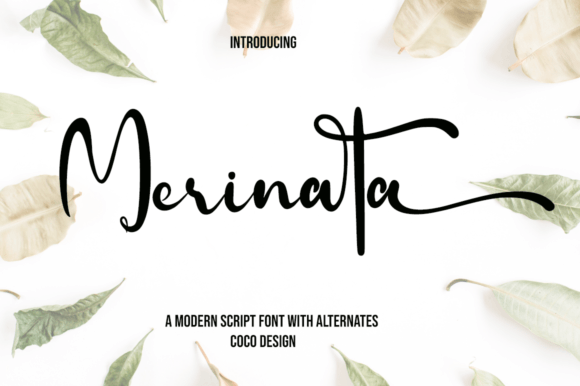
Merinata stands out among script fonts not by chasing trendiness, but by balancing authenticity with polish. It’s a carefully crafted handwritten typeface—designed to feel personal and intentional, not hastily scribbled or overly stylized. Its charm lies in its consistency: each letterform carries subtle variation, natural flow, and gentle contrast, yet maintains legibility and structural cohesion across sizes and contexts. For professionals who rely on typography to reinforce tone—whether launching a boutique brand, designing wedding stationery, or crafting editorial visuals—Merinata offers a reliable, expressive tool that avoids the pitfalls of many decorative scripts.
What Makes Merinata Distinctive in Practice
Unlike many script fonts that sacrifice readability for flourish, Merinata prioritizes both. Its lowercase letters feature soft entry and exit strokes, modest swashes, and open counters—details that support clarity at small sizes (e.g., business cards or email headers) without losing warmth. Uppercase characters retain a hand-drawn rhythm but avoid excessive ornamentation, making them suitable for logos or short headlines where impact matters more than density.
The font includes extensive OpenType features—ligatures, contextual alternates, and discretionary swashes—all accessible through standard design software (Adobe Illustrator, Photoshop, Affinity apps, etc.). Crucially, Merinata is PUA encoded. This means designers can access alternate glyphs, flourishes, and stylistic sets directly via keyboard shortcuts or glyph panels without relying on complex OpenType feature toggling—a practical advantage when working under deadline pressure or collaborating with non-designers who may not know how to enable advanced typographic controls.
Real-World Performance Across Mediums
In print applications, Merinata holds up exceptionally well. On wedding invitations printed on cotton paper, its fine strokes translate cleanly; on matte-finish thank-you cards, it conveys sincerity without looking fragile. Its weight distribution prevents ink spread, and its x-height sits comfortably between traditional calligraphic scripts and modern brush fonts—giving it flexibility across paper stocks and printing methods.
Digital use is equally dependable. At 16–20px, Merinata remains legible in email signatures or website hero text—especially when paired with a neutral sans-serif for body copy. It performs well in SVG exports for web logos, and its vector precision ensures crisp rendering on high-DPI displays. That said, it’s not intended for long-form body text: paragraph usage should be limited to short quotes, pull-outs, or accent lines where tone reinforcement matters more than scanning efficiency.
One practical observation: Merinata’s spacing is thoughtfully tuned—not tight enough to cause collisions, not loose enough to disrupt rhythm. Kerning pairs are refined for common combinations (e.g., “To”, “The”, “Love”), reducing manual adjustment time. Designers report spending less time fine-tuning letterfit compared to similar fonts, especially in multi-line logo lockups or stacked monograms.
Who Benefits Most—and Where It Fits Best
Small business owners launching lifestyle brands—think candle makers, ceramic studios, or wellness coaches—find Merinata effective for conveying approachability and craftsmanship without seeming generic. Its elegance feels earned, not applied, which helps differentiate offerings in saturated markets. A photographer might use it sparingly on a website banner (“Moments, curated.”) to signal intentionality; a florist could apply it to packaging tape or receipt stamps for tactile continuity.
Freelancers and agencies appreciate Merinata’s predictability across deliverables. A single license covers desktop, web, and app embedding (subject to vendor terms), simplifying asset management for client projects. Its cross-platform compatibility—including solid support in Canva for teams using templated workflows—means non-design stakeholders can apply it consistently without technical friction.
Educators and publishers use Merinata to add visual hierarchy to digital course materials or printed handouts—particularly for section headers, motivational quotes, or chapter openers. Its human quality helps soften academic or technical content, supporting engagement without undermining authority.
Strengths Worth Noting—and Minor Considerations
Merinata’s greatest strength is its restraint. It doesn’t overpromise. There are no dramatic flourishes that dominate layouts, no forced irregularity that distracts from message. Instead, it delivers consistent character, quiet confidence, and professional polish—traits that scale well from social media banners to embossed foil-stamped stationery.
Its PUA encoding deserves emphasis: this isn’t just a convenience—it’s a workflow enabler. When building a brand style guide, being able to document exact Unicode positions for swashes (e.g., “Alt ‘a’ = swash ‘a’ at U+E001”) streamlines handoff to developers or junior designers. It also supports accessibility-conscious practices: designers can keep semantic HTML intact (using or ) while applying Merinata visually—no need to replace text with images or SVGs to access glyphs.
Limited language support is the primary constraint. Merinata covers Latin-based languages thoroughly (including extended diacritics for French, Spanish, German, and Scandinavian use), but lacks Cyrillic, Greek, or Asian language glyphs. Projects requiring multilingual typesetting will need complementary fonts or fallback strategies.
Also worth noting: Merinata is a single-weight family. It does not include bold, light, or italic variants. This isn’t a flaw—it’s a design decision aligned with its purpose. Users seeking typographic contrast should pair it intentionally: a clean, geometric sans-serif (e.g., Inter, Manrope, or Montserrat) provides reliable counterbalance without competing for attention.
Practical Recommendations for Getting Started
If you’re evaluating Merinata for a project, test it early in context—not just as isolated words, but within your actual layout. Try it at the smallest size you’ll use (e.g., 10pt on a business card) and the largest (e.g., 60pt as a hero headline). Pay attention to how ascenders and descenders interact with surrounding elements, and whether swashes interfere with adjacent lines or icons.
For branding work, start with three core uses: a primary logo lockup (Merinata + sans-serif), a secondary accent treatment (swash initials or a short tagline), and a functional application (email signature or social bio). This reveals whether the font sustains its voice across touchpoints—or begins to feel repetitive.
When licensing, verify usage rights match your needs: desktop-only licenses won’t cover web embedding or SaaS product integration. Reputable vendors provide clear terms, and many offer trial versions with full glyph access—use those to assess PUA functionality before purchasing.
Merinata doesn’t try to be everything. It excels where authenticity, elegance, and usability intersect—on invitations that reflect care, logos that feel human-scaled, and communications that balance personality with professionalism. For creators who treat typography as part of their craft—not just decoration—it’s a quietly capable choice that earns its place in a working toolkit.