Winternight: A Refined Handwritten Font for Clarity and Quiet Confidence
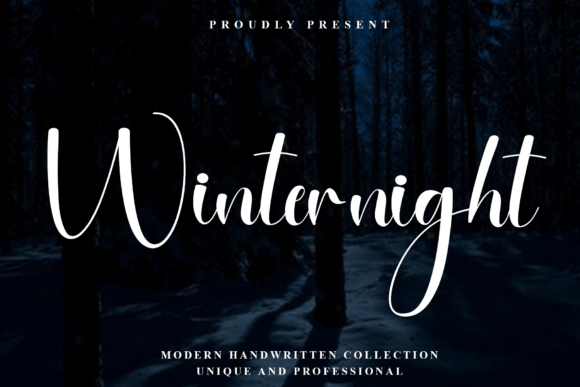
Winternight stands apart in today’s crowded landscape of handwritten typefaces—not by shouting louder, but by speaking with precision. It’s not a script meant for playful doodles or casual notes. Instead, Winternight is a carefully engineered, professional-grade font designed for contexts where authenticity meets intentionality. Its value lies in its restraint: tall x-heights, fine vertical strokes, and a gentle, consistent slant that reads as both deliberate and effortless. That balance—between structure and softness—is what makes Winternight more than just another decorative option. It’s a functional tool for designers and communicators who need handwriting to carry weight without sacrificing legibility.
What Makes Winternight Distinctive—Beyond Aesthetics
At first glance, Winternight’s elegance feels intuitive. But closer inspection reveals thoughtful construction. Each glyph maintains tight stroke contrast—thin hairlines paired with subtly reinforced terminals—giving it crisp definition at sizes as small as 14px on screen. Unlike many handwritten fonts that rely on heavy variation or exaggerated flourishes, Winternight achieves character through proportion and spacing. Its airy slant (roughly 8–10 degrees) avoids the instability of extreme cursive angles, while still conveying motion and warmth. The baseline alignment is exceptionally consistent across weights and variants, reducing visual “jumping” in multi-line headings or captions—a practical advantage often overlooked until it’s missing.
The family includes regular and italic styles, each with full Latin-1 support and standard OpenType features like contextual alternates and ligatures. These aren’t ornamental extras; they’re functional refinements. For example, the ‘f’ + ‘l’ ligature avoids awkward collisions in words like “flourish” or “fly,” and the alternate ‘a’ and ‘g’ glyphs provide subtle typographic rhythm without disrupting readability. No variable axis is included, which keeps file size lean (~35 KB per style) and ensures predictable rendering across platforms—including older CMS environments and email clients that struggle with variable fonts.
Where Winternight Delivers Real-World Value
Winternight excels where tone and clarity intersect. Travel photographers use it for minimalist portfolio titles—its clean lines complement natural light and uncluttered composition without competing for attention. Outdoor gear brands apply it to product tags and packaging copy because it conveys craftsmanship and quiet confidence, not manufactured excitement. In web design, it functions well as a display face for hero sections or testimonial quotes, especially when paired with neutral sans-serifs like Inter or Manrope for body text. Its legibility holds up well on high-DPI screens and remains discernible even with modest color contrast (e.g., charcoal gray on off-white).
One practical strength is its adaptability across media. Print samples show crisp reproduction at 6pt in brochures and 24pt on signage. Digital testing across iOS, Android, and desktop browsers confirmed reliable fallback behavior—no unexpected glyph substitution or rendering glitches. That reliability matters when deploying across multiple touchpoints: a brand’s Instagram bio, a Shopify product page, and a PDF lookbook should all reflect the same voice. Winternight delivers that consistency without requiring custom hosting or complex CSS workarounds.
Who Benefits Most—and When It Might Not Fit
Winternight suits professionals who prioritize coherence over novelty: small business owners launching a boutique hiking apparel line, educators designing nature-based curriculum materials, freelance designers building identity systems for eco-conscious studios, or bloggers curating slow-living content. Its quiet authority works best when the message is grounded—think “crafted in the Rockies” rather than “EPIC ADVENTURE!!!”
It’s less suited for high-energy contexts: children’s apps, loud festival branding, or interfaces demanding rapid scanning (e.g., dashboard alerts or dense data tables). While highly legible, its thin strokes can fade in low-contrast UI settings or on projectors with limited brightness. Also, users needing extensive language support—beyond Western European languages—will find its character set limited. There’s no Cyrillic, Greek, or extended diacritic coverage, so global-facing SaaS tools or multilingual editorial sites may need supplemental fonts.
Integration and Workflow Considerations
Installing and using Winternight follows standard font protocols. It works natively in Figma, Adobe Creative Cloud, and modern web environments via @font-face declarations. For web use, self-hosting is recommended over third-party CDNs—this avoids render-blocking requests and gives full control over loading strategies (e.g., font-display: swap). A typical implementation uses two weights (regular and italic), keeping total font load under 80 KB—well within performance best practices.
In design systems, Winternight pairs cleanly with geometric sans-serifs (like Poppins or Space Grotesk) for contrast, or with warm neutrals like Lora for editorial depth. Avoid pairing it with other handwritten fonts—even subtle ones—as its distinct rhythm can clash. One tested combination that consistently performed well: Winternight headlines over Inter body text, with 1.5 line height and generous letter-spacing (0.02em) on uppercase headings. This preserves its airy feel without sacrificing density where needed.
A Measured Choice for Intentional Communication
Winternight doesn’t try to be everything. It doesn’t mimic calligraphy, simulate brushwork, or chase trend cycles. Instead, it offers something increasingly rare: a handwritten font built for longevity, not virality. Its strengths—consistency, legibility, restrained personality—are most visible over time: in a brand’s second year of use, in a blog’s tenth redesign, or in a photographer’s evolving portfolio. It supports the message rather than overshadowing it.
For creators weighing options, Winternight earns consideration when the goal is understated sophistication—not ornamentation. If your audience responds to sincerity over spectacle, if your content values space and silence as much as statement, and if your workflow demands reliability alongside refinement, then Winternight isn’t just appropriate—it’s quietly essential. It won’t solve every typographic challenge, but where it fits, it elevates—calmly, clearly, and without fanfare.