Enchanting Font
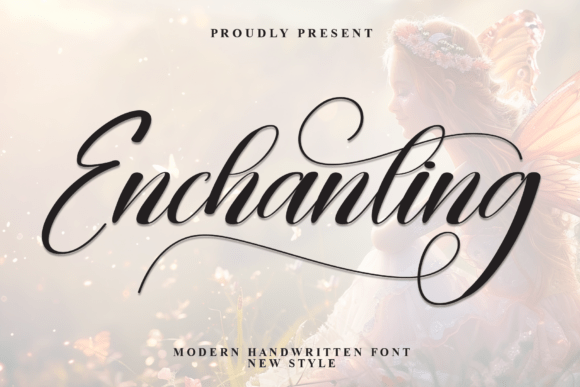
Enchanting is a modern handwritten script font designed to evoke whimsy, elegance, and narrative depth. It features high-contrast strokes—thin hairlines paired with bold, expressive downstrokes—as well as fluid loops and extended, dramatic swashes. These characteristics give each letterform a sense of motion and individuality. The font is PUA-encoded, meaning all alternate characters, ligatures, and swash variants are accessible without specialized software or OpenType feature activation, simplifying implementation in common design tools.
Who Might Consider Enchanting?
Designers and brand creators working on projects with strong thematic or emotional intent may find Enchanting relevant. This includes those developing visual identities for boutique businesses, crafting wedding stationery, designing book covers for fantasy or romance genres, or producing packaging for artisanal or luxury goods. It’s also used by illustrators and marketers seeking to reinforce a dreamlike or storybook tone through typography alone.
Strengths and Practical Benefits
The primary strength of Enchanting lies in its expressive consistency: the rhythm and contrast across characters support legibility at larger sizes while maintaining stylistic cohesion. Its swashes and alternates allow for nuanced typographic hierarchy—such as distinguishing headlines from subheads—without switching fonts. Because it’s PUA-encoded, users can access stylistic variants directly via keyboard shortcuts or character panels, reducing reliance on advanced OpenType support in older applications or web environments.
For print-based work—especially invitations, labels, or packaging—Enchanting performs well when set at 24 pt or larger. Its graceful curves and generous spacing help avoid visual crowding, and its high contrast lends itself to foil stamping or embossing techniques common in premium physical materials.
Limitations and Tradeoffs
Like many decorative script fonts, Enchanting has functional constraints. Its low x-height and tight counters reduce readability at small sizes or in long-form text. It is not suitable for body copy, UI interfaces, data-heavy layouts, or accessibility-critical contexts where consistent letter recognition matters (e.g., signage, legal disclaimers, or instructional materials).
Web use requires careful consideration. While embeddable via @font-face, variable weight options are not available—Enchanting is offered as a single weight. This limits typographic flexibility in responsive layouts where bold or light variants might otherwise support hierarchy or contrast. Additionally, its swash-heavy default glyphs may not render uniformly across all browsers or operating systems unless fallbacks and CSS font-feature settings are explicitly managed.
Licensing is another practical factor. Commercial use typically requires a separate license tier, and embedding in apps or digital products may involve additional permissions. Users should verify license terms before deploying Enchanting in client work or scalable digital products.
When Enchanting Fits Well
Enchanting aligns best with projects where typography serves as intentional storytelling—not just information delivery. Examples include:
- Fantasy-themed book titles or chapter headings where tone reinforces genre expectations;
- Wedding suites where elegance and personalization are central to the aesthetic;
- Boutique skincare or candle branding aiming for artisanal, romantic, or mystical associations;
- Social media graphics or posters emphasizing short, evocative phrases (e.g., “Once Upon a Time,” “Forever & Always”);
- Invitations or certificates where tactile quality and visual distinction elevate perceived value.
In these cases, the font’s personality supports, rather than competes with, the message. Its visual richness becomes part of the communication—not merely decoration.
When Alternatives May Be More Appropriate
If your project demands versatility across multiple weights, languages, or technical environments, other script fonts may offer broader utility. For example:
- More robust OpenType support: Fonts like Brittany Script or Shelby include contextual alternates, stylistic sets, and automatic ligature substitution—features that streamline complex typographic control.
- Better multilingual coverage: Enchanting supports basic Latin characters but lacks extended diacritics for Central or Eastern European languages. Fonts such as Caflisch Script Pro or Great Vibes offer broader language support out of the box.
- Improved screen legibility: For hybrid print-and-digital campaigns, fonts like Parisienne or Dancing Script balance hand-drawn charm with more open apertures and higher x-heights—making them more adaptable to smaller screens or lower-resolution displays.
- Accessibility compliance: If WCAG contrast or reading order requirements apply, pairing Enchanting with a highly legible sans-serif for supporting text is advisable—and sometimes necessary.
Making an Informed Choice
Evaluating Enchanting should begin with clarity about your project’s core goals. Ask: Is the priority emotional resonance or functional performance? Does the design context reward expressiveness—or require neutrality and adaptability?
Test the font early using real content—not placeholder text. Try setting your actual headline or tagline at intended sizes, both on screen and in print mockups. Pay attention to how swashes interact with adjacent letters, especially in all-caps or punctuation-heavy phrases. Check whether default glyphs align with your brand voice—or if frequent manual glyph substitution will add time to production.
Compare licensing scope against usage plans. A one-time desktop license won’t cover SaaS platforms or embedded PDFs distributed to clients. Review the foundry’s documentation for permitted use cases, and confirm compatibility with your primary tools (e.g., Adobe Creative Cloud, Figma, Canva, or web frameworks).
Finally, consider pairing strategy. Enchanting works most effectively when balanced with a neutral, highly legible companion font—for body text, captions, or interface elements. Sans-serifs like Inter, Montserrat, or Lora (for serif contrast) often provide effective counterpoints without competing visually.
In summary, Enchanting is a purpose-built tool—not a universal solution. Its value emerges most clearly when matched to specific creative needs: evoking wonder, suggesting narrative, or elevating moments that benefit from deliberate, artful typography. Understanding its boundaries helps ensure it enhances rather than hinders your final outcome.