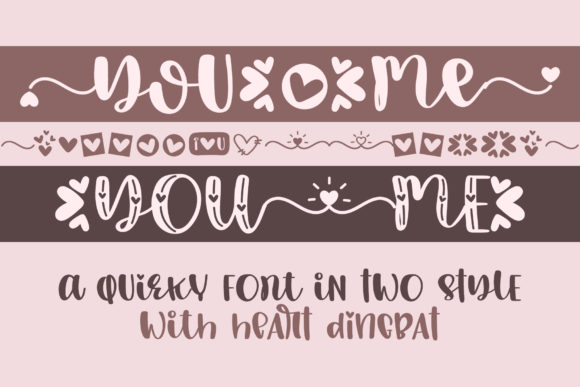
You Me
You Me is a handwritten typeface designed with warmth, rhythm, and quiet intention. It’s not just another script font—it’s built for legibility without sacrificing personality, and crafted to feel personal without drifting into illegibility. Released with PUA (Private Use Area) encoding, it gives designers full access to alternate glyphs, contextual swashes, ligatures, and stylistic variations directly from standard keyboard input—no complex OpenType panels required. That technical detail matters: it means You Me integrates smoothly into everyday design workflows, whether you’re using Adobe Creative Cloud, Affinity apps, or even modern web-based tools like Figma or Canva.
A Romantic Tone, Not Just a Decorative One
The romantic theme in You Me isn’t expressed through excessive flourishes or theatrical drama. Instead, it emerges in subtle ways: the gentle upward tilt of ascenders, the soft tapering of terminals, the slight irregularity in stroke weight that mimics natural pen pressure. Letters flow into one another with organic spacing—not rigidly kerned, but thoughtfully balanced—so words breathe rather than crowd. This makes You Me especially effective where emotional resonance matters: wedding stationery, boutique packaging, personal branding for wellness coaches or lifestyle bloggers, or editorial features focused on relationships, self-reflection, or slow living.
Unlike many decorative scripts that rely heavily on initial capitals or isolated flourishes, You Me maintains consistent rhythm across lowercase and uppercase alike. Its lowercase ‘a’, ‘g’, and ‘y’ include graceful, open forms—not cramped or overly stylized—so body text remains readable at sizes as small as 14–16pt in print or 18–20px on screen. That reliability expands its use beyond headlines and logos into short-form captions, quote overlays, or email newsletter headers where tone and clarity both matter.
Practical Strengths in Real Workflows
PUA encoding is the quiet advantage that sets You Me apart from many similarly themed fonts. Because every swash, alternate, and ligature lives at a dedicated Unicode position, designers can activate them by simply typing—no need to toggle OpenType features or switch between character panels. In practice, this means faster iteration during client reviews, smoother collaboration with non-designers (e.g., marketing teams inserting copy), and fewer surprises when exporting or sharing files. For freelancers managing tight deadlines or educators preparing classroom materials, that predictability saves time and reduces friction.
It also supports multilingual Latin-based languages—including extended diacritics for French, Spanish, Portuguese, German, and Scandinavian languages—making it viable for international campaigns or bilingual content. While it doesn’t include Cyrillic or Greek, its coverage aligns well with common professional use cases in North America, Western Europe, and Australia.
Where You Me Fits—and Where It Doesn’t
You Me excels in contexts where authenticity and approachability are strategic assets. Small business owners launching a handmade goods shop might use it for product tags and Instagram bios; wedding planners often pair it with clean sans-serifs like Montserrat or Lato for contrast in invitations; independent authors choose it for book covers targeting readers of contemporary fiction or memoir. Its charm feels intentional, not forced—appropriate for brands that value sincerity over polish.
That said, You Me isn’t suited for high-density information environments. Avoid it for data tables, legal disclaimers, long-form blog posts, or UI labels where scanning speed and cognitive load are priorities. Its letterforms require slightly more visual processing than neutral sans-serifs or even structured serifs. Likewise, while it performs well in print and high-DPI digital displays, very low-resolution screens (e.g., older mobile devices or projected slides at small sizes) may soften its delicate strokes, reducing distinction between similar characters like ‘i’ and ‘l’ or ‘o’ and ‘e’.
Consistency Across Formats
You Me ships as a single OTF file with full glyph coverage—including numerals, punctuation, currency symbols, and basic mathematical operators. That simplicity helps maintain consistency across platforms: a logo designed in Illustrator renders identically when embedded in a PDF proposal or converted to SVG for a website header. No missing glyphs, no fallback substitutions. For publishers building branded templates or educators creating reusable slide decks, that reliability means less troubleshooting and more focus on content.
Its file size is modest (~180 KB), so embedding in web projects via @font-face has minimal impact on load times—especially when paired with proper subsetting (e.g., limiting to only Latin-1 + common accented characters). Developers can serve it efficiently without bloating page weight, and designers retain control over variable weight simulation (via CSS font-weight) if needed for hierarchy—though You Me itself is a single-weight design, which reinforces its cohesive, hand-crafted identity.
Audience Alignment: Who Benefits Most?
You Me serves professionals who prioritize expressive clarity over neutrality. Think: freelance graphic designers building brand identities for yoga studios or ceramic artists; content creators producing Patreon newsletters with an intimate voice; indie publishers designing poetry chapbooks; or small retail teams crafting seasonal social media campaigns. Its value lies not in versatility across all applications—but in depth within a specific emotional and aesthetic range.
Entrepreneurs launching service-based businesses—especially in coaching, therapy, or holistic wellness—often find You Me resonates with their audience’s expectations: warm but grounded, personal but professional. It avoids the cutesy trap of many handwritten fonts while still feeling human. That balance is rare—and hard to replicate manually without significant time investment.
For educators developing classroom resources—think handouts for creative writing units or student project rubrics with encouraging language—You Me adds subtle encouragement without infantilizing. It signals care in presentation, reinforcing pedagogical intent. Similarly, nonprofit communicators working on donor thank-you cards or community event flyers gain warmth without compromising credibility.
Long-Term Usability Considerations
Fonts age differently depending on how they’re used. You Me’s restrained elegance helps it avoid trend fatigue. Unlike fonts tied to a specific decade’s design vernacular (e.g., ultra-thin serifs from the early 2010s or heavy distressed scripts from the mid-2000s), its foundation in natural handwriting ensures longevity. It won’t look dated next year—or five years from now—because it references a timeless behavior (the human hand writing slowly and deliberately), not a passing aesthetic.
Still, responsible usage matters. Overuse dilutes impact. Applying You Me to every headline, button, and testimonial on a website risks visual monotony and accessibility concerns. Best practice is strategic application: one primary script for voice-driven elements (taglines, quotes, callouts), paired with a highly legible supporting typeface for structure and function. That pairing strengthens hierarchy, improves scannability, and honors You Me’s intended role—not as infrastructure, but as accent.
Finally, licensing is straightforward: most versions include desktop, web, and app usage rights under a single commercial license. There’s no tiered pricing based on traffic or impressions, which simplifies budgeting for solopreneurs or growing teams. Updates are infrequent but meaningful—typically focused on expanding language support or refining problematic glyphs—not cosmetic revisions that force rework.
If your work regularly calls for type that conveys sincerity, intimacy, or quiet confidence—and you’ve found other handwritten options either too fragile, too busy, or too difficult to implement—you’ll likely find You Me refreshingly capable. It doesn’t try to be everything. It does one thing well: giving written language the gentle, unhurried presence of someone speaking thoughtfully, just to you.