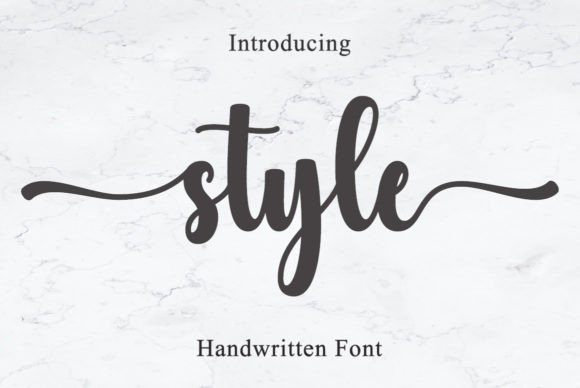
Style: A Strategic Handwritten Font for Meaningful Communication
Style isn’t just another handwritten font—it’s a precision tool for designers, brands, and communicators who understand that typography carries intention. Its elegant, confident strokes aren’t decorative flourishes; they’re calibrated signals. When you choose Style, you’re not selecting a “pretty script”—you’re deploying a visual language that conveys sincerity, care, and human presence without sacrificing clarity or professionalism.
Why Style Fits Real-World Strategy—Not Just Aesthetics
Most handwritten fonts fall into one of two traps: they’re either too casual to support serious branding, or so ornate they compromise legibility and versatility. Style avoids both. Its letterforms balance rhythm and restraint—each curve intentional, each spacing considered. That makes it unusually adaptable across contexts where authenticity matters but credibility can’t be compromised: a boutique law firm’s welcome email, an educator’s workshop handout, a sustainable brand’s product label, or a therapist’s appointment card.
This adaptability is strategic. It reduces the need to juggle multiple fonts for “human” versus “professional” touchpoints. With Style, you maintain tonal consistency while varying hierarchy—using weight shifts, size, or pairing with a clean sans-serif—rather than switching type families entirely. That saves time in design systems, strengthens recognition, and supports long-term brand coherence.
When Style Delivers Measurable Value
Use Style deliberately—not decoratively. It earns its place when the goal is to deepen connection, signal intentionality, or elevate perceived value. Consider these grounded use cases:
- Customer-facing print materials: Wedding invitations, thank-you cards, and limited-edition packaging benefit from Style’s warmth and craftsmanship. Here, it reinforces emotional resonance and justifies premium pricing—not because it’s “fancy,” but because it signals that the sender invested attention in the detail.
- Digital-first communication: In email headers, landing page quotes, or social media graphics, Style adds distinction amid algorithmic noise. Paired with system fonts for body text, it creates contrast that guides attention without slowing readability.
- Brand identity elements: Logos, monograms, or signature lines where personality must coexist with scalability. Style’s PUA encoding ensures consistent access to ligatures, stylistic alternates, and swashes—so your logo remains expressive whether rendered at 16px on mobile or 8 feet tall on a storefront.
- Educational and creative assets: Course workbooks, lesson headers, or portfolio presentations gain approachability without diluting authority. Learners and clients alike register effort and care in the typography—subtly reinforcing trust in the creator’s expertise.
How to Use Style Intentionally—Not Automatically
Start with the outcome, not the font. Ask: What feeling should this element evoke? What action should it support? Who needs to read it—and under what conditions?
If the answer is “clarity first,” Style works best as a headline or accent—not body text. Its strength lies in brevity and emphasis. A business card with Style used only for the name (paired with a neutral sans-serif for title and contact details) feels curated, not cluttered. A quote graphic using Style for the attribution line—while keeping the quote itself in a highly legible serif—creates hierarchy that mirrors how people actually scan content.
Test contrast rigorously. Handwritten fonts can blur at small sizes or on low-resolution screens. Always preview Style at its intended usage size—especially in email clients or printed collateral. If characters merge or spacing feels uneven, scale up or simplify the application. Better to use it once with impact than three times without legibility.
Risks of Using Style Without Strategic Guardrails
Like any expressive tool, Style can backfire when applied without context. Overuse dilutes its effect—imagine an entire website built in Style. It becomes exhausting, not elegant. Worse, inconsistent application (e.g., switching between alternates arbitrarily across materials) signals indecision, not creativity.
There’s also a perceptual risk: if your audience associates handwritten fonts with informality, Style may unintentionally undermine authority in high-stakes contexts—like investor decks or compliance documentation—unless carefully anchored by structure, color, and supporting typography.
And remember: accessibility isn’t optional. While Style itself is not inherently inaccessible, poor contrast ratios, insufficient sizing, or lack of fallbacks in web implementation can exclude users. Always pair it with WCAG-compliant color combinations and ensure screen readers encounter semantic HTML—not just styled text.
Planning Tips for Long-Term Typography Decisions
Treat Style as part of a system—not a standalone solution. Before licensing or embedding it:
- Map your core touchpoints: List every place typography appears—email, website, print, social, signage—and note which currently lack a distinct, human-aligned voice.
- Define functional boundaries: Decide where Style lives (e.g., “only for headlines, signatures, and short quotes”) and where it doesn’t (e.g., “never for body copy, data tables, or legal disclaimers”). Document this in your brand guidelines.
- Test with real users: Show two versions of a key asset—one with Style, one without—to a small group in your target audience. Ask what tone they infer, what action they’d take, and what feels most trustworthy. Their responses often reveal misalignments no designer anticipates.
- Build fallback logic: If using Style on the web, declare robust font stacks and test rendering across devices. Have a visually harmonious fallback ready—not just Arial, but a carefully chosen alternative that preserves hierarchy and mood.
Style Beyond the Surface: What It Reveals About Your Approach
Choosing Style says something about your priorities. It suggests you value nuance over speed, resonance over reach, and craft over convenience. But those values only translate into results when paired with discipline—when you resist the urge to apply it everywhere “just because it looks nice.”
The most effective users of Style treat it like a signature: reserved for moments that warrant personal imprint. A founder signs their annual letter in Style—not their internal Slack messages. A florist uses it on the ribbon tag of a delivery box—not the packing slip. These choices don’t just look better; they train audiences to recognize significance in subtlety.
That kind of intentionality compounds. Over time, consistent, thoughtful use of Style contributes to what psychologists call “perceived reliability”—the quiet confidence people assign to brands that make coherent, restrained choices. It’s not flashy. It doesn’t trend. But it endures.
Final Thought: Style Is a Verb, Not Just a Noun
In practice, Style asks you to slow down—to consider not just how something looks, but how it lands. Does this invitation feel warm without seeming unpolished? Does this logo communicate care without sacrificing memorability? Does this card make the recipient feel seen—not just addressed?
Those questions matter more than any font spec sheet. Style gives you the tools. Your judgment determines whether those tools serve your goals—or simply decorate them. Use it where humanity needs emphasis, not ornamentation. Anchor it in purpose, not preference. And when in doubt, ask: does this choice make the message clearer, the connection deeper, or the outcome more likely?